

It is possible that Uzbekistan may not be at the forefront of travel lists of most people.However, the fascinating country in Central Asia has a lot to offer.There are many places to visit in Uzbekistan.From the cities of the Silk Road, Samarkand and Bukhara, to the numerous palaces and museums, he hosts four important UNESCO World Heritage sites that you cannot miss.
In Uzbekistan, the weather is good everywhere in May, June, July, August and September
The best months to go to Tachkent are March, April, May, June, July, August, September and October
On average, the hottest months in Tashkent are June, July and August, and the coldest month of the year is January
Cities with the best climate are Tashkent, Boukhara, Termez, Chakhrisavz and Sherobod, with a good time at least 8 months a year
 This building with a blue dome in the center of Tashkent is a traditional bazaar.It is a popular place for both tourists and locals, because here you can get everything, from clothes and goods to delicious food.Madrasa Kukeldash is located at one end of the bazaar.
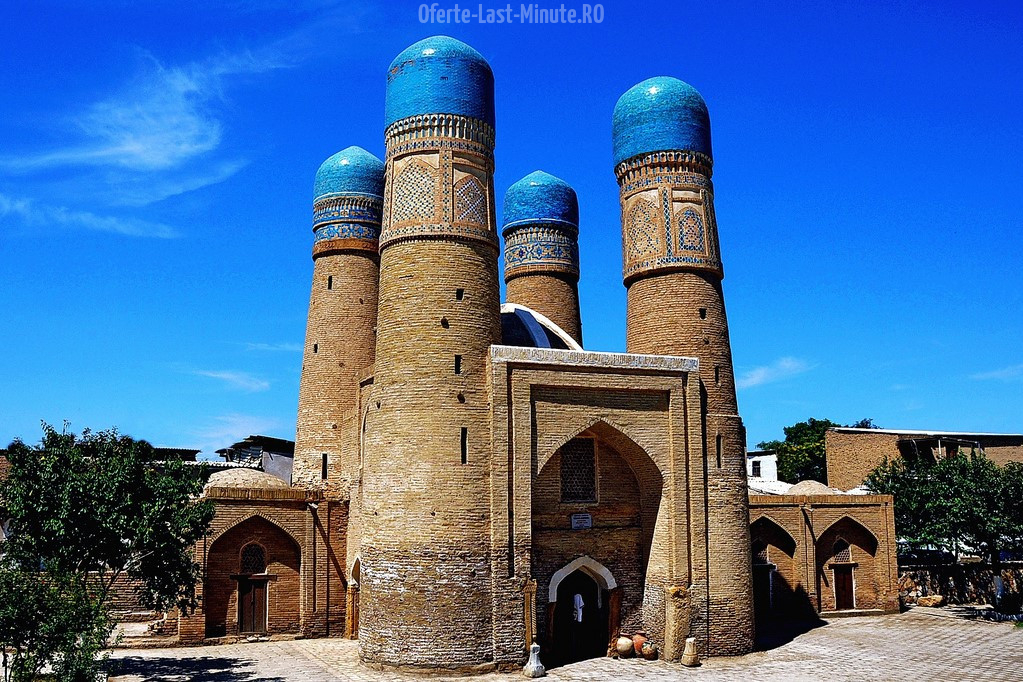 This historical mosque located northeast by Bukhara was built in the eighteenth century by a rich trader, Khalif Niyazkul.The four minarets for which it is called the mosque (Chor Minor means literal "four minarets") symbolize the four cardinal points.Each also has unique decorations.
 Gūr-e amīr is the mausoleum of the Mongolian conqueror Timur from the fourteenth century.It is literally translated by the "tomb of the commander", it has a beautiful groove.The mausoleum is also the resting place for two of Timur's sons and grandchildren.The tomb also inspired the Lughal architecture in India, especially the tomb of Humayun and Taj Mahal.
 This semi-artificial lake was created by the Soviets near a smaller seasonal lake.Today, it covers over 4,000 square kilometers in the middle of the Kyzylkum desert.It is also a popular place to go to the campsite or to spend the night in a traditional yurt.
 Built in the 1600s, Lyab-I Hauz is a serene market built around one of the few ponds (Hauz) left in Bukhara.The pond itself is powered by an ancient system of channels and is surrounded by beautiful nozzles.South of Lyab-I-Hauz is the historical Jewish district of the city.
 The Aral Sea was once a massive water body between Uzbekistan and Kazakhstan.It was a major source of fish and so many fishing cities, like Muynak, have grown throughout its shores.However, the Aral Sea has decreased since the 1960s because of the bad management of irrigation.Most of it turned into a dry desert, full of rusty vessels.
 The Amir Timur Museum in Tashkent is dedicated to the Mongol Timur conqueror.He was opened in the capital, Tashkent, in 1996, after the country earned its independence.The museum has over 5,000 artifacts related to Timur and the dynasty that followed it, the Timurid dynasty.The building itself is meant to resemble the Gur-e amir mausoleum in Samarkand.
 Also known as the KarakalPakstan State Art Museum, this Nukus museum contains over 82,000 objects, largely collected by IV Savitsky.These include antiquities from Khorezm to Karakalpak folk art, Uzbeca plastic art, the second largest Russian avant -garde collection.
 Previously known as the National Museum of Turkestan, this is one of the oldest museums in Central Asia, founded in 1876. It has over 250,000 exhibits that reflect Uzbeca history from prehistoric to modern.These include: a Buddha's relief of Gandharan alabaster well preserved from the Terms;Tamerlan calligraphy;and art and ethnic costumes.
 The ancient city of Khiva, also known as Khorasam, is over 2,000 years old.The inner city built Itcha Kala, was the first Uzbec site added to the list of UNESCO World Heritage sites.Surrounded by creneled brick walls, it is full of fascinating places and historical monuments.Entering the built city is like you return in time.
 This is the palace of the last leader of Khanat Kokand, Khudayar Khan.Often called the "Pearl of Kokand", it was built in 1871 and covers four lush -green ground acres.He once had seven courtyards and 119 rooms.However, only two courts and 19 rooms are open to the public today.
 The Registan Square in Samarkand has once called one of the most beautiful markets in the world and is easy to understand why.This public market was the heart of the ancient city of Samarkand during the Timurid dynasty.It is known for its beautiful Islamic architecture and three imposing marshes.In Tadjik, Registan translates to "sandy place".
 "Zindan" means prison in Persian, and this prison, built in the eighteenth century, was used to host criminals and dissidents during the Bukhara emirate.Able to host up to 40 prisoners, the brick structure also has a circular pit.After the fall of the Bukhara emirate in 1920, the Zendan of the Emir stopped working and, finally, was transformed into a museum.

