
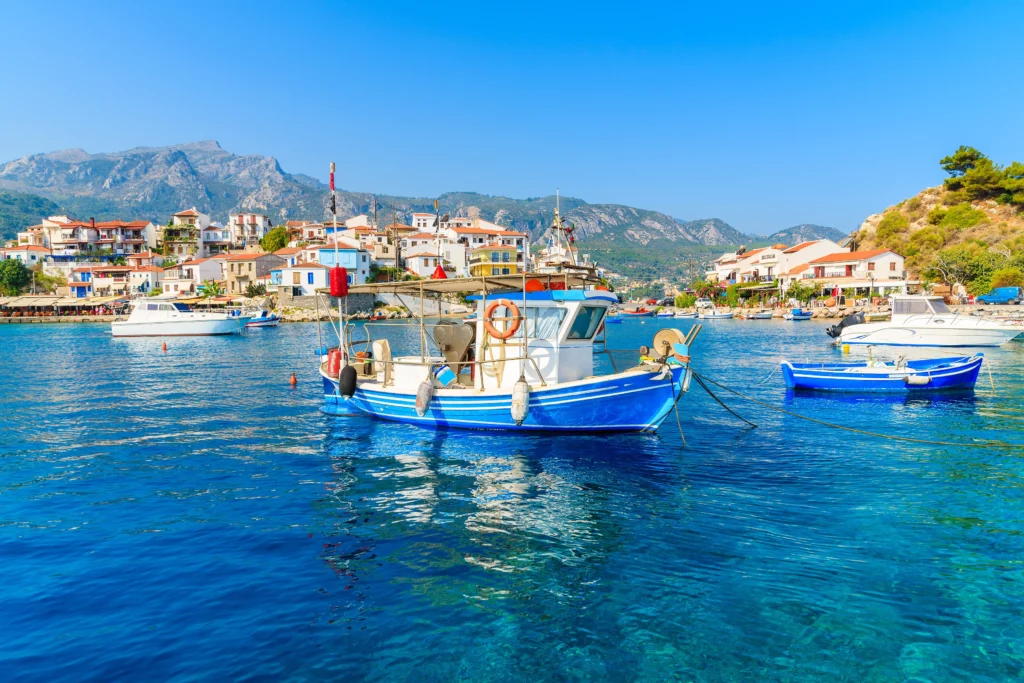
Sámos hilly (Turkish: Sisam) island is close to Turkey, which is separated by a strait of only 1.9 kilometers wide.Fertile and densely forested, it has only recently become a target for mass tourism and still retains the charm of its past professions, which turned around agriculture, boat construction and fishing.
About
Best period
The best months for good weather in Samos are March, April, May, June, July, August, September, October and November
On average the hottest months are July and August
The coldest months are January and February
The best months for swimming are June, July, August, September and October
Tourist Attractions
 In the northeast of Samos, Potami Beach is one of the most photogenic beaches on the island.Located just west of the second largest city in Samos, Karlovas, the beach extends along two connected bays.There are a number of restaurants on the seashore with gravel, and they have sunbeds and umbrellas.From here, you will have wonderful views of both bays.Potami beach is also a few steps away from nearby waterfalls and a longer hike to Mikro Seitani Beach.
 You will need to drive three kilometers on a ground track to reach Livadaki Beach, in the northeast corner of Samos, but many swear it is worth the injured road to reach.A bay withdrawn with good kayak, the beach can have wind.The water is very clear here when the wind does not blow.There are also shower and toilet facilities.It has a varied menu that includes a lot of salads.
 Lemonakia beach is a few steps away from Kokkari and is a popular place for swimmers and beach in summer.Just 100 meters from the main road, the beach with gravel and sand has calm water than other beaches in the area, which makes it ideal for swimming.The water has a clear, turquoise shade.You can look at a lounge chair for hours.Go to the small tavern on the beach for food. N nlemonakia can be crowded in the summer.For fewer agglomerations, visit Tsamadou Beach, which is within a few steps.
 Kokkari is a former fisherman's village transformed into the city colored resort from the northern part of the island, just 10 kilometers from the city of Samos.It has a long gravel beach, with clear blue water, which is particularly popular among Windsurfers.It takes you through olive orchards, and the walk is so beautiful that you will hardly notice that you ureize.Once you get to Vourliotes, take a piece of food to one of the taverns before returning back to the mountain at Kokkari.
 Mount Kerkis amounts to 1,434 meters in the center of the southern portion of Samos and can be climbed on a hiking route.If you do not want to go up, there are a lot of other hiking routes on its flanks.The rural landscape around Mount Kerkis also presents a quieter and less developed part of the samos. In naici you will find only a few quiet fishermen and a single adequate area in Votsalakia (also known as Kampos).If you are interested in hiking on the mountain, go to this resort on the beach to inform you about routes.While here, you can relax on its beautiful white sandy beach.Other beautiful beaches from here include the beautiful and ultra quiet Psili Ammos beach, which also hosts a series of restaurants that serve fresh fish and other local dishes.
 In a bay sheltered from the northeast coast of the island, the city of Sámos (also known as Vathy or Vathi) was founded in 1832 as a specially built capital of the island.The elegant neoclassical style houses surround the port in the form of a horseshoe, many of them now accommodating cafes and restaurants on the water's edge, while modern concrete apartments extend along the coast and on the hill overlooked.From here, regular ferries circulate to and from Piraeus port in Athens.
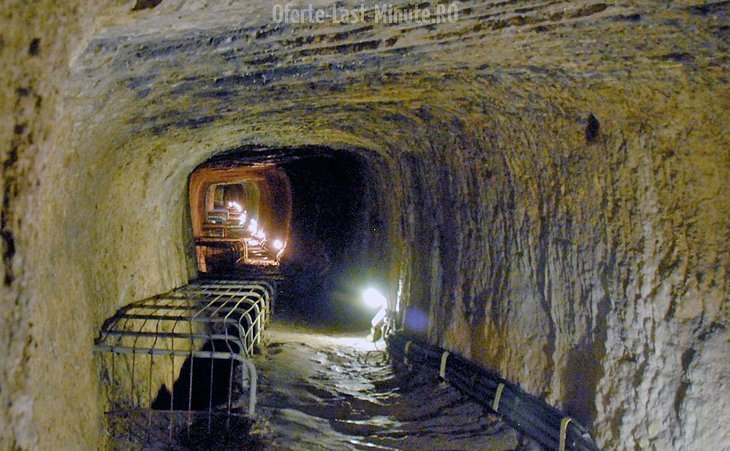 Once considered one of the miracles of the world, this underground aqueduct is two kilometers west of Pythagorion.Built by Eupalinos in the 6th century BC, it is a kilometer long and about 1.75 meters high and width.The excavation started from both ends and met successfully in the middle, which is impressive, considering that it was before the occurrence of topography and mapping.At about 425 meters from the entrance, you can see the point where the two wells meet, making an almost perfect combination.
 Eight kilometers west of Pythagorion is Heraion, the Temple of Herei, one of the top tourist attractions of the island.On this place was built a succession of temples from the eighth century BC, culminating with a colossal structure of about 45 meters per 80 meters, supported by at least 100 columns, which was started around 570 BC n Instrument was destroyed 30 years later in a Persian raid.A replacement was planned on an even larger scale and would have been the largest Greek temple ever built, but has never been completed.The findings on the site are exhibited in the archaeological museum in the city of Samos.
 On a hill behind the city of Pythagórion is the White and Strange Monastery Panagia Spiliani (the monastery of the Virgin Mary's Cave), founded in 1586. From the entrance, 95 steps go down to a large, cool and quiet cave, with a church at the end, which is adorned with religious icons.From the monastery, you have amazing views to the city and over the sea, to the Turkish coast.
 On the southern coast of the island, the friendly city of Pythagorion was known as Tigáni until 1955, when he was renamed to honor Pythagoras, who was born here.Built around a sheltered bay, now full of fishing boats and smart yachts and with views of cafes and taverns with seafood, it was once the ancient port in Sámos, a powerful sea and commercial state in the 6th century BC.A small archaeological museum exhibits archaic and Hellenistic funeral stars (funeral stones), marble statues, coins and ceramics discovered in the area.

