

Corfu is the most popular of the ionic islands, being located in the northern part, near the Albanian coast, which is separated by a strait with a width from 3 to 25 km.This is also a prefecture that contains a series of small islands nearby, of which the most important are the Paxoi and Othonoi Islands.
About
Best period
On Corfu Island, the weather is good everywhere in April, May, June, July, August, September and October
The best months to go to Paleokastrítsa are April, May, June, July, August, September and October
On average, the hottest months in Paleokastríts are July and August, and the coldest months are January and February
November is the most humid month of this city
Tourist Attractions
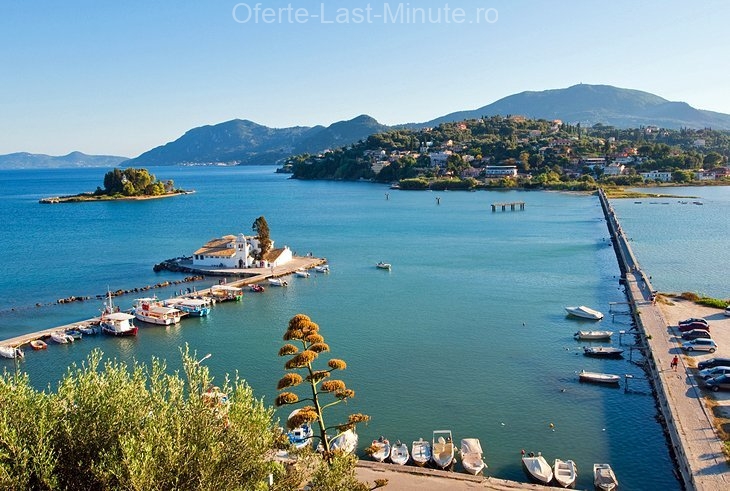 To the south of the center, off the southern peak of Kanóni, two small islands rise from the sea.On the closest one, which is reached on a road road, is the Vlakhérna Monastery in the seventeenth century, and beyond that is the island of the mouse (Pontikonísi), crowned by a vanished Byzantine chapel and a group of cypress.A peaceful escape from the crowd, Pontikonísi is often presented on illustrated postcards.Catch a boat from Kanóni port to get here
 Kanoni is very easy to reach, by bus from Squianada Square.It is a popular meeting place among the locals, and its name has as its origin the name of an ancient tun that can be seen today on the top of the hill. Below Kanoni is the Panagia Vlacherna church, dating from the seventeenth century and the Pontikonissi island, also known as the Mouse Island, which will be a 5 -minute ride.the most photographed attractions of the city.
 The medi streets are dominated by a fortress dating from the fifteenth century, a Venetian architectural masterpiece raised on the site of a former Byzantine tower.
 Right behind the Liston cafe is hidden the Church of Saint Spiridon, whose bells can be seen precisely from the ferries that bring visitors to Corfu.The architecture and its interior deserve at least a few moments of attention.
 The second largest market in Europe, the Spianada Square was built by the French, during the wars worn by Napoleon. In this is the heart of the city, the place where locals and tourists meet to enjoy a coffee, to take lunch, or to play the cricket, a memory left by the English.
 Achilleion is about 10 kilometers from the city of Corfu and is an impressive piece of architecture with a sad story.It was built in 1890 as a summer palace for Empress Elisabeta Austria, a tragic figure that was affected by misfortune (her husband was unfaithful, and her son committed suicide) and was eventually assassinated in 1898. Often mentioned by her nickname, Sisi, the Empress had the villa decorated in the Pse-Classic style, and the Pse.fresco.Inside, you will discover vintage furniture, paintings and even some of Sisi's clothes.Whatever you do, do not skip the garden area.It is a highlight of a visit and is full of statues from the 19th century and superlative views at sea.Reach this attraction by public bus in the city of Corfu
 A paradise of peace and tranquility, right next to the Arcada Liston, this church bears the name of the Holy Patron of Corfu, Saint Spyridon.Built in 1589, the bell with red dome dominates the horizon from afar.Inside, in a lateral chapel with a low light, decorated with warm frescoes, notice a silver sarcophagus adorned with precious stones, which includes the remains of the Holy Spiridon.And, before he died, he became a bishop and began to do wonders.As his remains are in Corfu, the locals believe that his miraculous intervention has saved their island from a catastrophe on several occasions.The silver coffin containing its relics is paraded around the city to mark important religious festivals and, in his honor, spiros is the name of the most popular boy on the island.
 Near Mon repos, the small church of Saints Jason and Sosipater is dedicated to two of the disciples of Saint Paul who brought Christianity to the island in 70 AD.It is a typical example of Byzantine architecture from the eleventh century, based on a cross -square and made of large stone blocks, probably taken from the ancient buildings nearby.Unfortunately, they were white in 1820, but there are some fragments of paintings.However, there is an impressive iconostasis from the eighteenth century (the screen between nave and altar) and some beautiful religious icons
 Built by the Venetians in 1546 on the site of an older castle, the magnificent old fortress is on a small rocky peninsula, immediately to the east of the old city.It is accessed from the esplanade through a bridge that extends on a ditch, the famous counterfeit, which has a depth of about 15 meters and a width of up to 40 meters. In the city there is a small church, in the style of a Doric Temple, which the British built in the 19th century.Make sure you go up to the highest point of the site, which is marked by a lighthouse, because from here you have magnificent views of the city and East over the sea to Albania
 Between the closely packaged buildings of the Old City and the Old Fortress, the esplanade (Spiana) is a vast green space and claims to be the second largest market in Europe.The main public gathering space in Corfu, is overlooked by the Arcade Liston, built by the French in the 19th century and hosts a series of expensive cafes, which are ideal for watching people.Locals play Cricket (a game that has been sent to the British) on the carefully cared for the esplanade and there is also a tape stand in which the band occasionally plays
 Located in a beautiful park and approached along a boulevard with boulevard, is the neoclassical palace in Mon Repos, the birthplace in 1921 of the ASR Prince Filip, the Duke of Edinburgh.Built in 1831 for the High British Commissioner, it was later used as a summer house of the Greek royal family.In addition to the fact that it is a tourist attraction, it is used to host conferences.You will find it in the Kanoni area of the city, for a pleasant 30 -minute walk and also served by the public bus
 A climb up, besides the outdoor market, with sales of seasonal fruits and vegetables, brings you in the massive new fortress, built in 1577 Venetians to protect the city against the Turks, making it a little more "new" than the Old Fortress.Once inside, you are free to walk through the empty halls and passages and, best, to climb the top for amazing views on the terracotta roofs of the old and sea.The entrance ticket also covers a free drink at the small cafe
 Established in 1816 as a Royal Palace for the High British Commissioner, the Asian Art Museum is one of the top things to do in the city of Corfu.Today, the neoclassical mansion at the northern end of the esplanade is a remarkable museum. In an impressive collection of paintings, porcelain and Chinese, Japanese and Indian sculptures, dating from the Neolithic era to the 19th century.There is also a wonderful cafe in the yard, with fantastic views over the sea channel to Albania

