

The second largest city in Sicily, according to Palermo, the main attraction in Catania is its baroque architecture.Founded by the Ionian Greeks in 729 BC, Catania thrived as an agricultural center and remained after it became a Roman colony.
About
Best period
The best months for good weather in Catania are March, April, May, June, July, August, September, October, November and December
The coldest months are January and February
Tourist Attractions
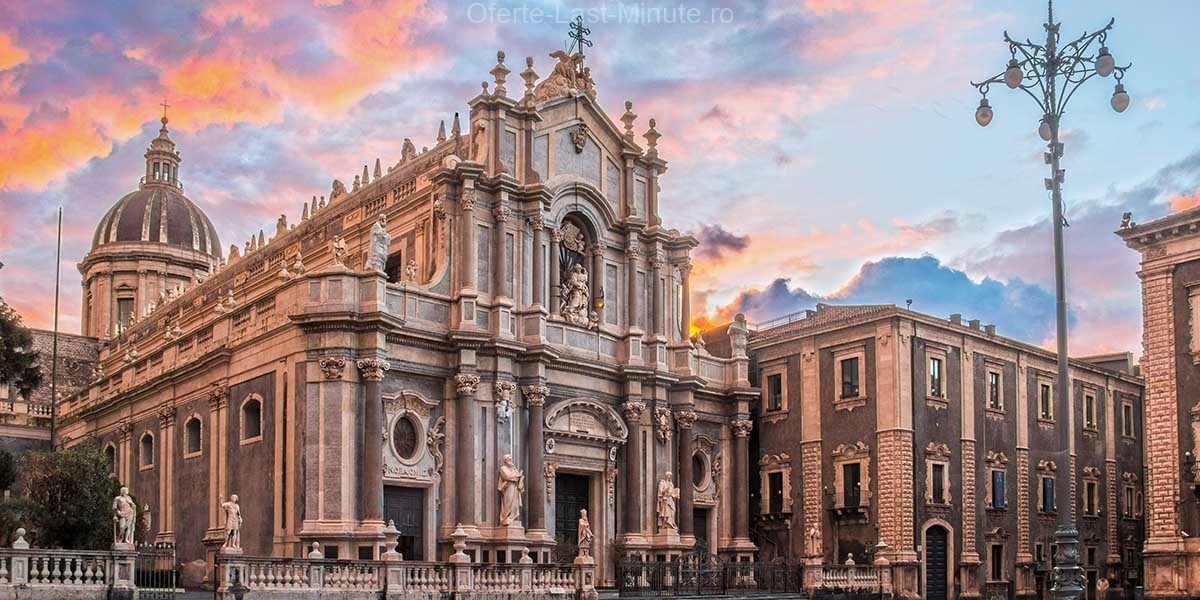 The cathedral in the ditch is, according to tradition, on the place where Saint Agatha died in 251 at the death of a martyr and began between 1086 and 1090, shortly after Catania was conquered by the norms.The remnants of the Roman springs of Achilles and other ancient buildings were used to build the three -winged cross -shaped basilica.During the reconstruction after the earthquake of 1693, the nave was rebuilt under the guidance of Girolamo Palazzotto, and in 1736, Vaccarini completed the facade.
 Palazzo Biscari is still in private property and lived as a result of the descendants of the prince of Biscari, who ordered his building between 1707 and 1763. The facade of the palace is one of the most flamboyant in the city;You cannot help observe the ornamental windows and door frames.Ignazio Biscari, the nephew who initially ordered the palace, has expanded it to create space for his art collections, many of them since then the Civic Museum.The inner courtyard has a large double scale, and the opulent interior includes a Rococo dining room with mirrors, stuces and frescoes.Otherwise, there are paintings, marble floors, several frescoes and stucco works and a small museum with artifacts that were not donated to the museums of the city.Check at the travel office to see when the interior tours are offered (the reference to the audio tours on the front sign indicates that the palace is discussed in the city audio tour).
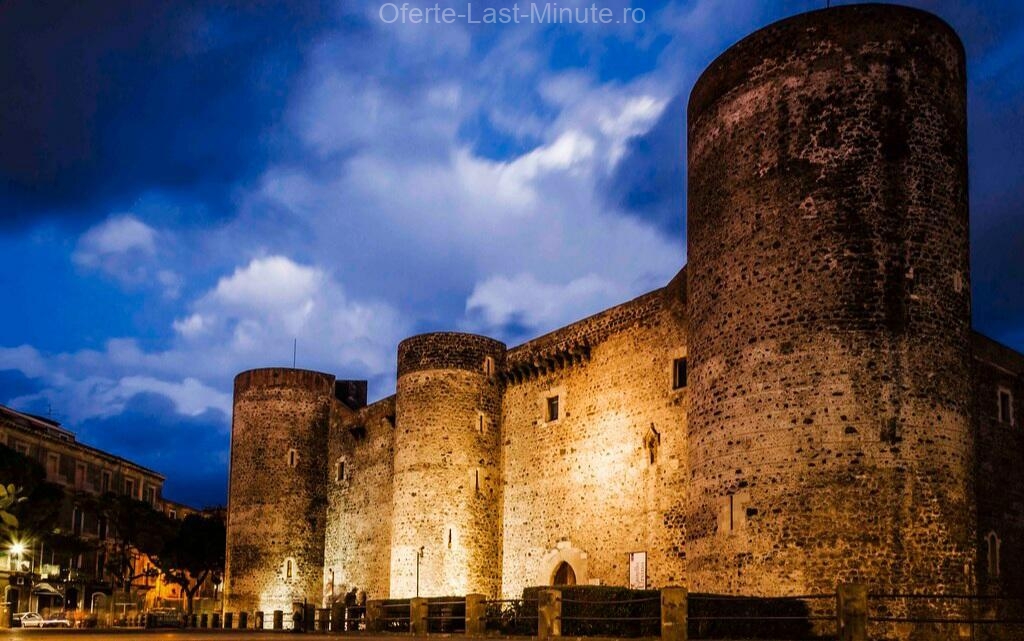 Castello Ursino is a sturdy building built of lava stone in 1239. This defensive fortification of the Hohestaufen period of the Middle Ages demonstrates a close affinity with Frederick II Castle in Syracuse.The plane-plane consists of four wings around an inner courtyard;The four wings form a square with towers in corners and four smaller towers halfway along each side.The decorative elements are rare;On the input side to the north you can see an eagle that captures a rabbit.The initial castle was sitting right next to the port, until the big lava river of 1669 passed on the western side (it can still be seen there) and pushed the coastline to the east.Today, the castle occupies a spacious space in the middle of a residential area.
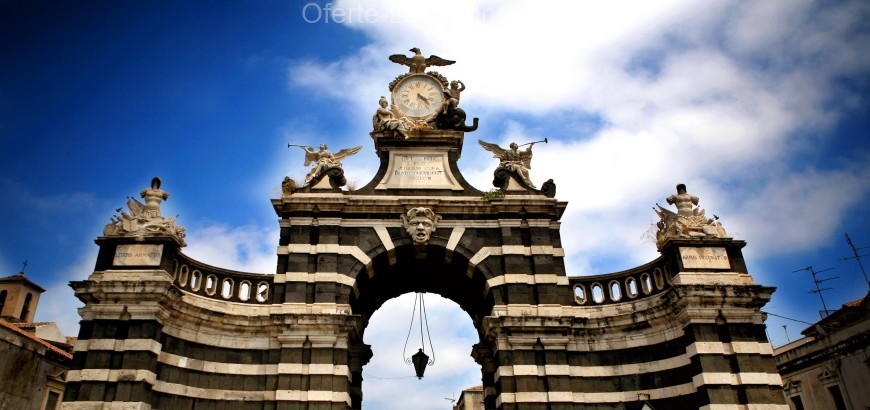 The monumental gate of Porta Garibaldi was erected in 1768 in honor of King Ferdinand IV and his consumer Maria Carolina, the daughter of Empress Maria Theresa.The architects were Francesco Battaglia and his successor Stefano Ittar, who designed a striking gate with dramatic white limestone and black lava.The part with which the city faces is simpler, the west -oriented part has concave wings and is crowned by a clock between two winged figures, symbolizing glory.
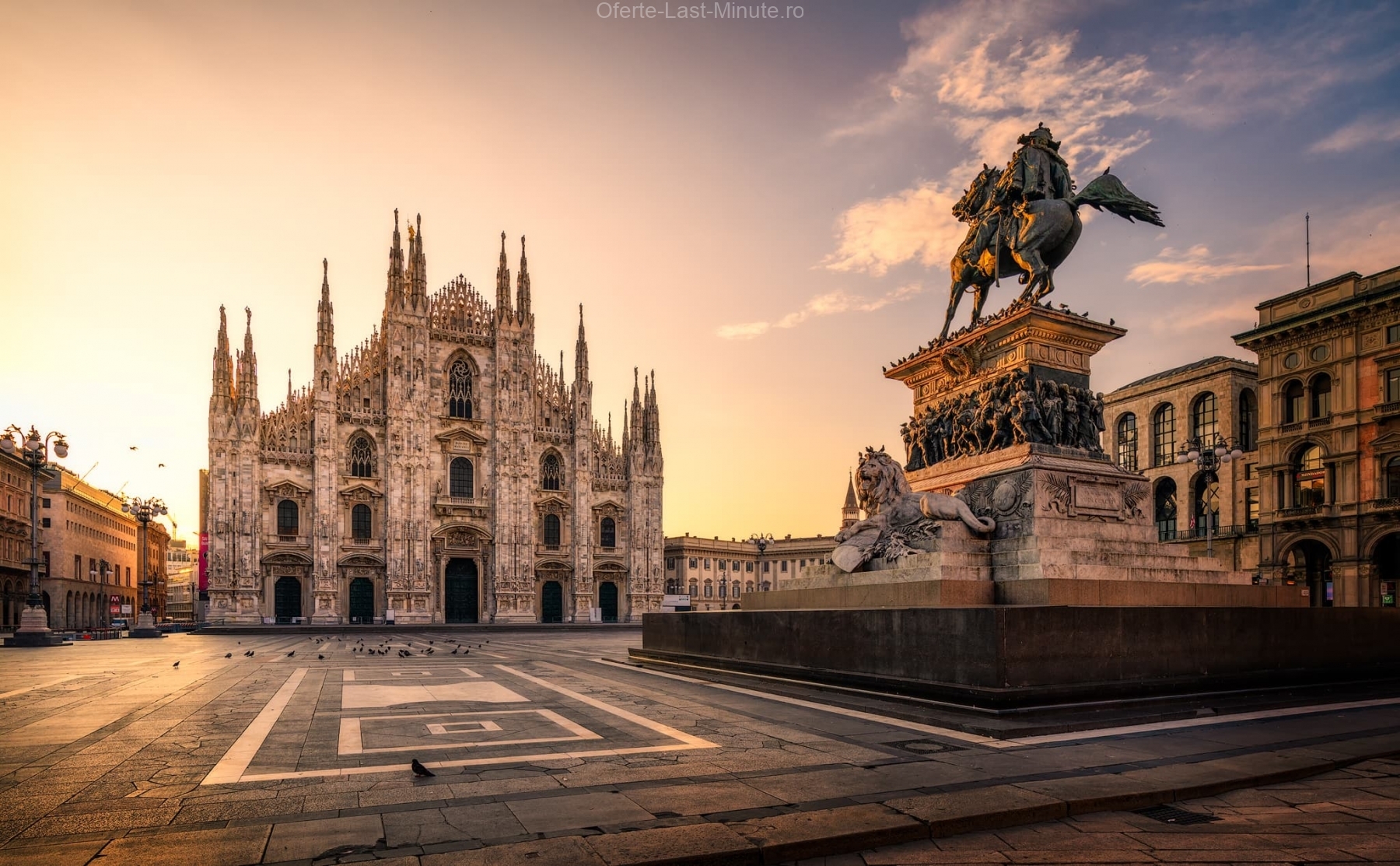 Catania has a number of wonderful squares, but no better - or spacious - than Piazza del Duomo.The Cathedral Square is the center of the city and preserves the baroque appearance, conferred by Giovanni Battista Vaccarini at the beginning of the eighteenth century.Around the fountain of the elephant on the east side is the Baroque modified cathedral between 1730-1739 and the church dedicated to the Holy Patron of the city, Sant 'Agata, built between 1737 and 1767. In the northwest is Palazzo del Municipio (1741), and in the south, Porta Uzeda-all created by Vaccarini.The beautiful Fontana dell elefante, a black lava elephant who supports a small Egyptian obelisk, was inspired by the Obelisk of the elephant Bernini in Rome.From the southwest corner of Piazza del Duomo street, Via Garibaldi occupies the passing Piazza Mazzini at Porta Garibaldi.To the north of Piazza del Duomo, on both sides of Via Etnea, is the heart of the Baroque area, with its wide streets and well -defined markets.
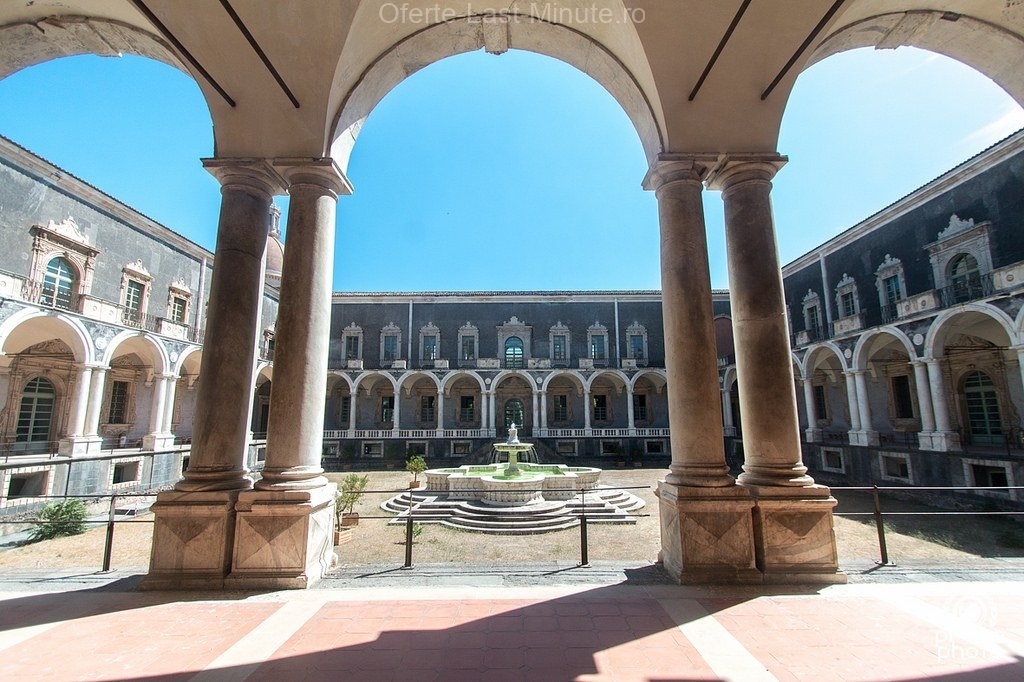 On the site of the Greek acropolis, Benedictines began to build the Church of San Nicoló in 1702, together with the monastery monastero dei Benedttini buildings.The works at the church continued until the end of the eighteenth century, but they were never completed.It gives the incomplete facade a strangely forbidden appearance, the pairs of massive columns that end suddenly on high full, and the cloves that should keep their stones in front still prominent like hair.A large dome overlaps the simple interior, with three wings, which has a meridian in 1841 in transept;Centuries in the 18th century choir;and the great famous body of Goethe, built by Donato del Piano between 1755 and 1767. From the dose is a beautiful view to Mount Etna (you can request access to the dome from Sexton).
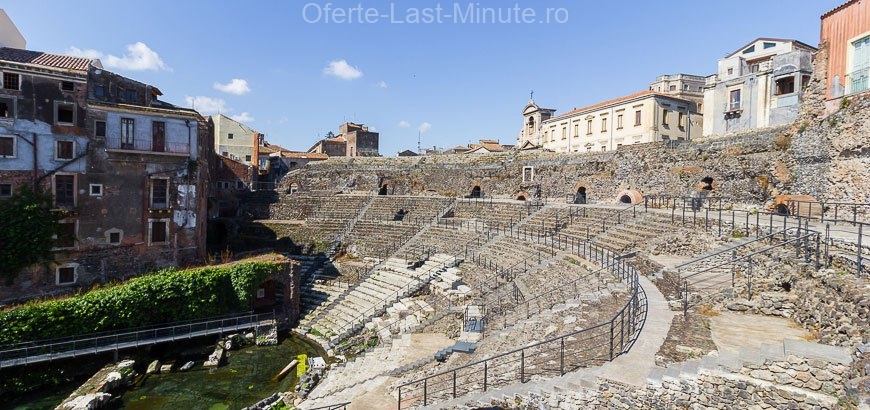 On the southern slope of the old Acropolis is the Romano Theater (Roman Theater), built in the second century BC, on the site of a Greek building.The room has a diameter of 100 meters with two perimeter passages.The steps are made of lava, while the orchestra and the residence rows are covered with marble.Adjacent to the Romano Theater in the West is Odeon, a small theater whose orchestra is at the same level as the highest corridor in the theater.Odeon is built entirely from the lava.

