

with his past turbulent, ended by the war, Belgrade is like a Phoenix rising from ash to become one of the hottest European capitals today
About
Best period
The best months for good weather in Belgrade are April, May, June, July, August, September and October
On average the hottest months are July and August
January is the coldest month of the year
Tourist Attractions
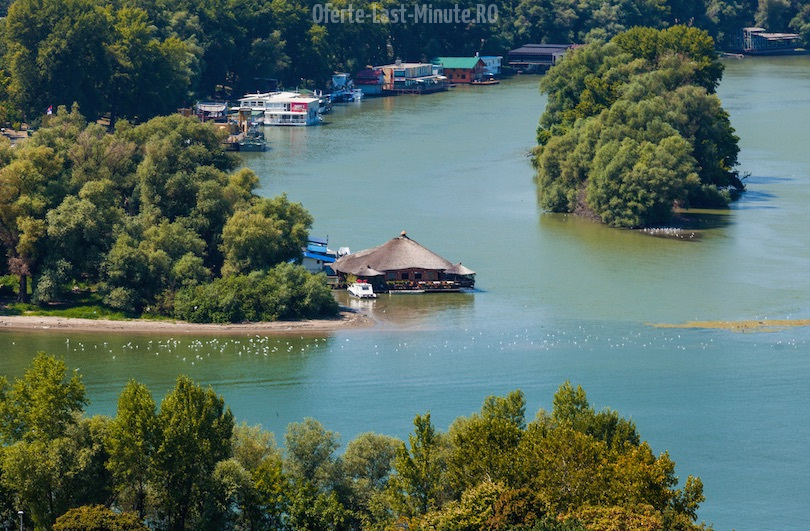 ADA CIGANLIJA is an island with the artificial peninsula in the River/Lake Sava passing through the center of Belgrade.With its beautiful beaches and sports facilities, Ada attracts over 100,000 visitors a day in summer.Nicknamed the "Belgrade Sea", Adei Peninsula is full of thick forests that resemble a wild area, so you might see deer, rabbits and foxes.Houseboats, a weekend refuge for residents in Belgrade, can be found at the northern end.Ada Ciganlija is the dream of an athlete with dozens of sports facilities, from tens to rugby to boating, with artificial facilities for alpine ski and snowboard.
 Josip Broz Tito led Yugoslav partisans in World War II, later becoming president of Yugoslavia.Leader respected on the international stage, died in 1980;He and his wife are buried at the Florilor House, also known as Tito's mausoleum.For a while, the flowers surrounded the tomb, giving birth to the name of the Flowers House;The flowers have now disappeared, replaced with white rocks.It was built in 1975 as a winter garden for Tito, who chose to be buried here.Today's mausoleum is part of the Yugoslav History Museum.
 The fortress due to its defensive strategic position, people lived at the confluence of Sava and Danube rivers from Neolithic.Then the invaders moved, first the Celts and later the Romans, who built a palisade here, followed by Huns and Goths.However, a Serbian leader was, in the fifteenth century, the one who really strengthened the fortifications here.The fortress is remarkably intact, occupying much of the area.In addition to the fortifications, the official area of the fortress includes a church, a museum and several popular parks.
 Crkva Svetog Marka, or St. Mark Cathedral, was practically completed in 1940 on the site of a wooden church dating from 1835.Not too far the Parliament building is too far..Above the exterior entrance to the church, you will find a mosaic of the apostle Mark for which the Church is named.The church is full of centuries -old icons;More rulers are buried in the crypt.
 More than a century ago, Nikola Tesla fed electricity, inventing the alternate current system, electric coil and related items.Generations later, these inventions would lead to a car named after him, the Tesla electric car.They also led to a museum dedicated to his work in the center of Belgrade.The Nikola Tesla Museum contains thousands of documents, books, photos and drawings related to its world electrification work.The museum also hosts interactive exhibitions, including computerized models of its inventions.
 Each city has one: a street that emanates charm, is bordered by historical buildings and is the place where buyers make bargains.In Belgrade, this street is Knez Mihailova Street, named after a Serbian prince.With less than one mile, the street dates from the Ottoman days, although it has not really become its own until the 19th century, when the rich began to build houses here.Historical buildings along the way include Hotel Srpska Kruna, built in 1869;Particular houses at 46, 48 and 50 Knez Mihailova, dating from the 1870s, and Greek Kraljica, a cafe in an 1835 building.
 Skadarlija street may not be very long, only 400 meters (1,340 feet), but it is the most famous street in Belgrade.Located in the old city, it connects Despot Stefan Boulevard to Dusanova street.The street is bordered by vintage buildings.With a bohemian atmosphere, Skadarlija Street is considered the Belgrade version of Montmartre in Paris.In fact, he was known as the Gypsy neighborhood in the 19th century.It is a place where poets gather for the Skadarlija evenings at the regretted Poet House Duksic and where the Children's Street Theater offers circus shows.Outdoor restaurants and cafes, including celebrities, from all over the corners.
 The Gardos tower is only a young man compared to ancient or medi monuments;It was built in 1896. But it is as impressive as anything built centuries earlier.He is also known as the millennium tower or the Tower of Janos Hunyadin, a Hungarian hero who died more than 400 years ago on the site of an older fortress.Some ruins in the previous fortress have remained today.Initially one of the five towers built by Hungarians to celebrate 1,000 years in the region, the landmark is located in Zemun, 20 km (13 miles) by Belgrade.
 The Avala tower, built in 1965 and destroyed by NATO bombings on Serbia in 1999, was rebuilt in 2010, becoming the highest telecommunications tower.The original tower, with an observation bridge, was a source of pride for the region.Public donations have paid for the tower reconstruction.It can be found on Mount Avala, on the outskirts of Belgrade.At 206 meters (675 feet) height, it is the fifth highest structure in Serbia;You can literally see miles and miles from the deck of observation.
 With a 134 -meter high dome (440 feet), the Temple of Saint Sava dominates the horizon of Belgrade.To make it even taller, the dome is locked with a golden cross of almost 12 meters (40 feet) height.The largest Orthodox church used today, is dedicated to Saint Sava, an important medi character who founded the Serbian Orthodox Church.It is located on the Viacar plateau, where it is believed that Saint Sava was buried.The construction of the white marble and granite church began in 1935, was stopped during World War II and resumed in 1985. Although it is still under construction today, it is already one of the most popular attractions in Belgrade.

