

Although it is a leading shopping and industrial center, the Bari crowded port city has a lot of charm for tourists passing through it on the way to Greece or ports from eastern Adriatic
About
Best period
The best months for good weather in Bari are April, May, June, July, August, September, October and November
The coldest months are January and February
Tourist Attractions
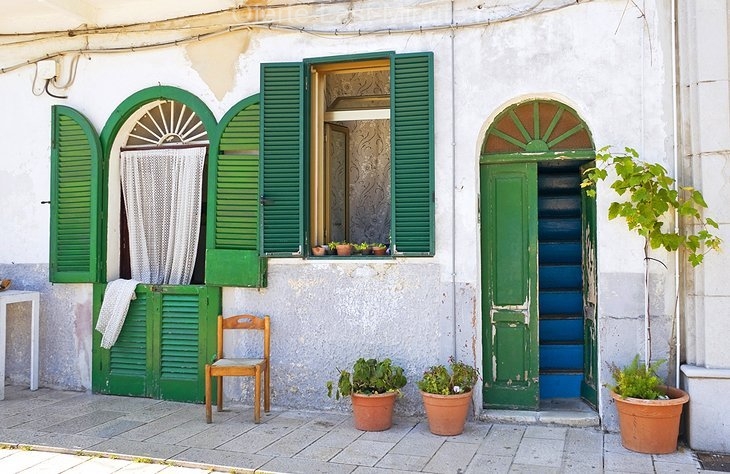 The narrow streets of the old city, some of them more like alleys, are interwoven in an atmospheric maze as they twist and turn through the narrow peninsula at the northern end of the bar.Among his old picturesque houses are several tens of churches and even more hidden altars in his small walls and squares.It is easy to lose yourself, but the area is small enough to be sure you will find the exit quickly or you will reach the cathedral or San Nicola.
 To the south of Bari, over the plateau, the wonderful city of Altamura is still partially surrounded by its old walls.The imposing cathedral was built by Frederic II in 1231, with subsequent modifications after an earthquake in the fourteenth century and a complete interior reversal in the sixteenth century.It is the most complicated carved portal in Puglia and one of the best in Italy, full of fine details, because several biblical scenes are represented in a very small space.In the eardrum, the Virgin and the Baby are shown with two kneeling angels, and below is one last unusual dinner in infinite details.Although the Cathedral really deserves the trip to Altamura, the city itself is delightful, with picturesque stone and arcade streets
 Borgo Murattiano is the shopping and business center in Bari, separate from the old city of the long and wide Vittorio Emanuele II, which was arranged in 1813. Its streets, as opposed to those in the old neighborhood, are straight and in an ordered grid, lined by elegant buildings, of which it has been many of which from the beginning of the 19th century.Others reflect the styles that followed, especially Art Nouveau, called Liberty in Italy, popular at the beginning of the 20th century.About halfway in Piazza della Libertà are the Municipal Theater and the Rococo-style Prefecture Palace.Near the distant end is the Venetian-Gothic Fizarotti Palace.Corso Cavour, bordered by trees, has several Liberty -style buildings
 On the western side of the old city is Castello (Castle), initially a Byzantine-Roman building, reconstructed by Frederic II in 1233 in Normand-Șvab style.Bona Sforza turned it into a palace in the sixteenth century, adding corner bastions and towers over the ditch.Later, it was used as prison and signaling station.Two towers of the Norman structure are still here.The building is now hosting an interesting museum with children of Apulian-Norman sculptures and temporary art exhibitions.
 Lungomare Augusto Imperatore follows the eastern shore of the old city to Mole San Antonio, where a small fort was transformed into a gallery for modern art.Beyond this is another shore promenade, Lungomare Nazario Sauro, a magnificent terrace on the seashore that stretches along the old port, Porto Vecchio.Although the boats in the port are colored at any time of the day, one of the most interesting things to do here is to arrive in the morning to see the fishermen downloading their captures to the pier.
 The ancient city of Egnazia, to the southeast of Bari, dates from the 13th century BC, when the peoples of the Bronze Age have settled here.Like other villages along the Adriatic shore, it was the prey of every invader from the East, until it eventually became a Roman city at the end of the third century BC.Start from the Excellent Museum for an overall image;Although the text is in Italian, the historical sequence is clear, and the exhibits include materials found in excavations that give life to the site.The walls built by the original colonists are still there, as well as the remains of ancient Greek and subsequent novels.The Roman period was the moment when the city flourished as an important port on the Traiana road that connects Rome to Brindisi, but was eventually abandoned in the tenth century, after they were successively devoted to Visigoths, Saraceni and Turks.Parts of the Traiana road, amphitheater, forum and two Christian basilics remain from the Roman era.
 At the edge of Borgo Vecchio is the pleasant Piazza Mercantile, whose cafes and abundant restaurants on the sidewalk are popular local meeting.The fate of the criminals and meanings of the meanings, which, in the Middle Ages, were not so pleasant, were related to Colonna della Gitia, a column in the corner of the market, for public ridicule.A very worn stone lion is standing next to the column. In the mercantile, the Mercantile is mixed at one end in Piazza del Ferrase, where you will find the triple apse of the Roman Church Vallisa, one of the oldest of the city.
 By far the most popular tourist attraction in Bari is the Basilica, which was built to house the relics of Saint Nicholas.At first glance it is simple, massive and somewhat forbidden, but a closer look reveals attractive details in the sculptures around its portals, where the stone animals seem to guard the entrances.Inside, above the large altar, there is a tabernacle from the twelfth century, and to the right of the altar is Madonna with the saints of Vivarini, painted in 1476. In the apse there is a throne of the bishop of marble and the tomb of Bona Sforza from the sixteenth century, the wife of King Sigismund II of Poland and the last Duchess of Poland.Silver from 1684, under which there is a vault containing the remains of Saint Nicholas.The remnants of the saint came to Bari from their original altar in Myra, now part of Turkey, when that city fell into the hands of the Saracens.They were stolen and, after a lot of quarrel by Venice, who also wanted them, were brought here with the justification that the Saint had chosen Bari as a funeral place as he headed for Rome.
 Attracting less attention than the San Nicola Church, but just as interesting is the San Sabino Cathedral Church, which has important Norman ornamentation remains.Beginning after 11 - the Byzantine Cathedral on this site was destroyed by William I in Sicily, in 1156, it was completed at the end of the 12th century.Much of the interior was restored to its Apulian Romanesque appearance, eliminating the baroque "modernizations" and rebuilding the beautiful pulpit.Inside the church are the remains of Saint Columba and the relics of other saints.In the crypt there is an elaborate decorated painting of Madonna and the relics of Saint Sabinus, brought to Bari in 844 from Canosa after being dismissed by the Saraceni.The Roman era until the medi era.The English signal explains the discoveries, which include a paleo -Christian mosaic floor and a tiny chapel and altar.A small section of an original Roman road was also discovered.
 The magnificent theater, the fourth largest in Italy, was completed in 1903 as opera theater and concert hall and hosted some of the great Italian and international performing artists, including Luciano Pavarotti, Rudolf Nureyev, Ray Charles, Liza Minnelli and Frank Sinatra.destroyed by fire.It was rebuilt exactly as it had originally shown, supplemented with the five levels of boxes and their dazzling decorations.It was reopened in 2009, with the orchestra in the province of Bari, playing the ninth symphony of Beethoven.Visiting it today, you would never guess this is not the original theater of 1903

