
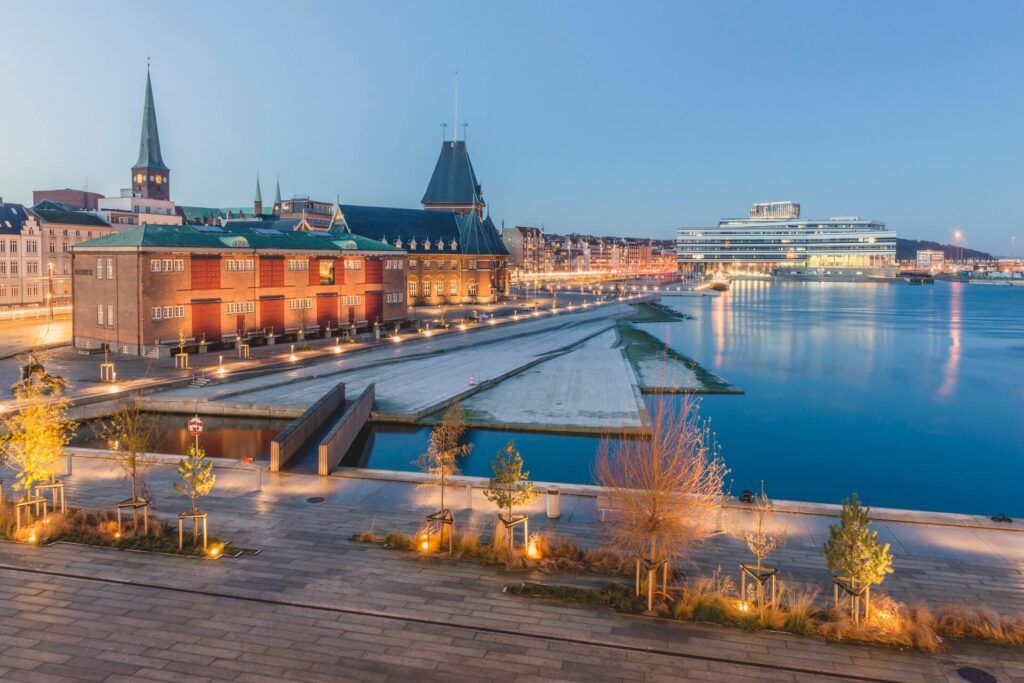
The second largest city of Denmark, Aarhus (or århus) is on the East Coast of the Jutland, where the Aarhus river is poured into the picturesque bay of the same name.Mentioned for the first time in 928 AD.As the headquarters of a bishop, he received the municipal status in 1441.
About
Best period
The best months for good weather in Aarhus are June, July, August and September
On average the hottest months are July and August
February is the coldest month of the year
The rainy months are July and August
Tourist Attractions
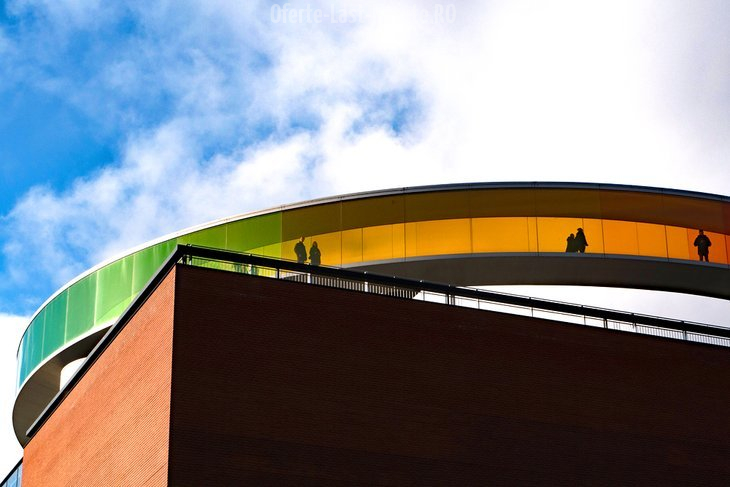 The AROS AARHUS (AROS AARHUS KUNSTMUSUM) Museum is one of the largest art museums in Europe.Hosted in a 10-storey impressive building, which is itself a work of art, the most remarkable work of architectural art is the rainbow panorama.Mounted on columns 3.5 meters above the roof, the bird is 150 meters long and three meters wide.As you walk it, you will get views of the city and bay in the colors of the rainbow.You can access your Rainbow through the 310-square-meter roof pavilion. In the most important collections of Kunstmuseum include works of art from the Danish gold (1770-1900), Danish modernism (1900-1960) and contemporary art.The works cover all genres and environments, including sculpture and installations.You can also participate in a show, enjoy a lecture or workshop, or join an English guided tour.
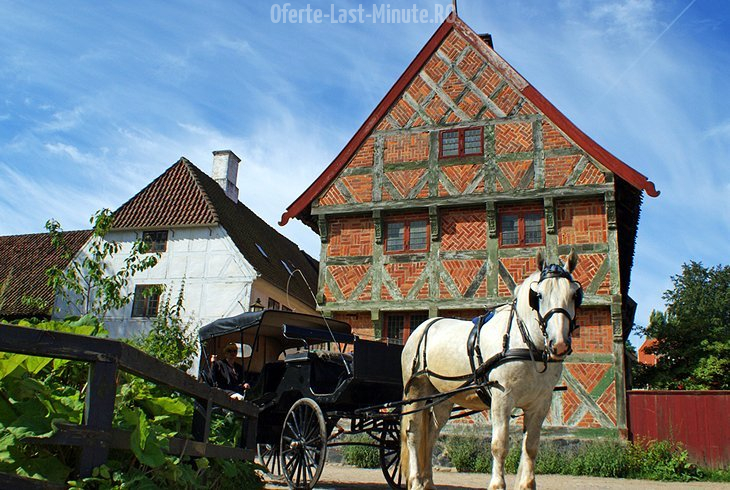 Den Gamle By, or the "Old City", is a fascinating outdoor museum, consisting of over 75 historical buildings collected from all over Denmark.Each of them has been disassembled and reassembled in Aarhus for preservation. By falling from the sixteenth century to the beginning of the 20th century, this remarkable collection was assembled as if it were really an authentic "old city".The effect is more increased by the fact that these beautiful old houses, shops, workshops and windmills still work as in the past and serve as a capsule of time that keeps a beside era.Also notable are the merchant's house, a house on pillar, a two -storey stone house and a warehouse.The largest building is the majestic Coin Master 'S Mansion, a newer "old" completion on the site in 2009. In the toy museum, a textile museum and a historical musical collection are worth it.So are the bicycle museum;The pharmacy store, complete with healing herbs;and the workshops once belonging to the candles, the tollar and the boots.The museum also organizes special exhibitions of historical costumes.They are also available tours guided in English by costumes.
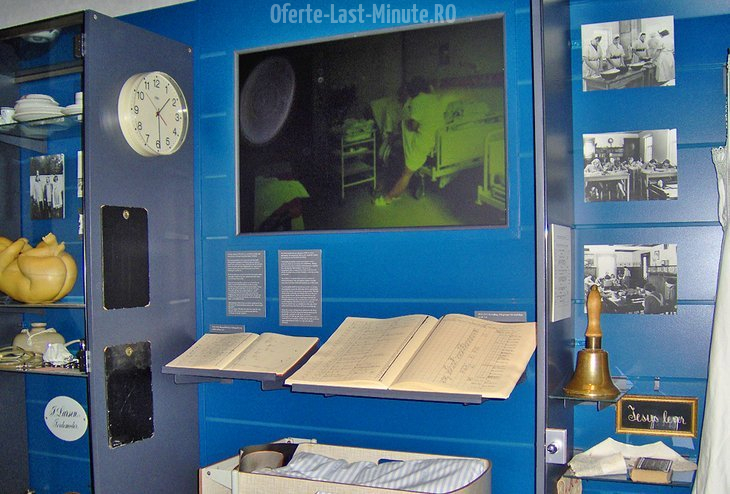 Founded in 1982, the Women's Museum (Kvindemuseet) in Aarhus is a unique organization designed to collect and maintain information about the lives of women in the country and their role in society and culture.Artifacts as diverse as wedding dresses, household equipment, paintings, crafts, cooking utensils, home decorations and other objects that have been part of women's daily life.These and the archive of documents, photographs and biographies that document the lives and work of women explore evolving changes in women's lives.
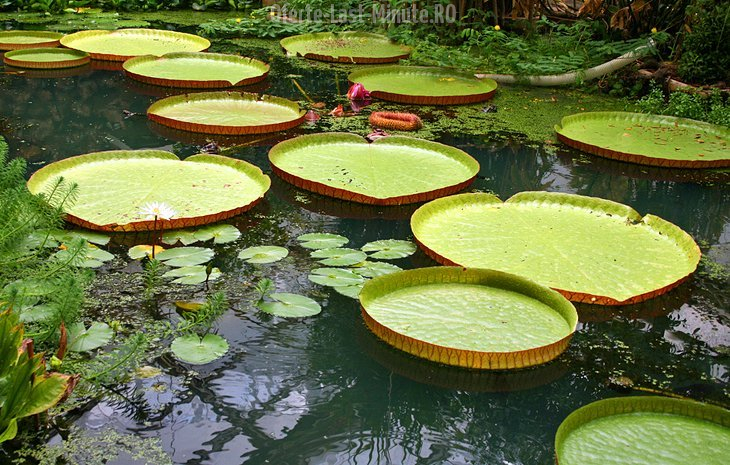 The Botanical Garden of Aarhus (Botanisk Have) was founded in 1875 and covers an impressive surface of 53 acres.The large greenhouses with subtropical plants from all over the world are renovated with the addition of a large tropical domestic, visitors can enjoy large plants from all over the world, which can be grown in four different climatic areas.Children have fun here in the summer, when they can find a lot of things to do, including special programs for children and concerts and shows in the garden amphitheater.Numerous paths cross the property, along with two small lakes and a lot of light green space.
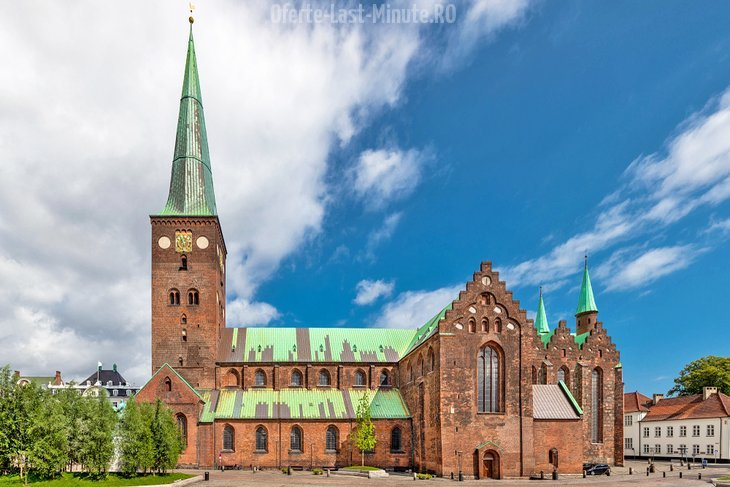 The picturesque inner city of Aarhus is made up of a semicircle closed by a ring road (Ringgade).In its heart is the Great Square (Torv Store) in which the Cathedral of Aarhus (St. Clemens Kirke) is dedicated to Saint Clement.also dates from this period.The current facade, with a single tower and the motive of the anchor, dates from the same period.Also, it is worth seeing the beautiful carved pulpit from the sixteenth century, two organs and a font.The vault paintings date from the fifteenth century and depict Saint Clement as the Patron of the Church and Christ sitting.http://aarhusdomkirke.dk/english/
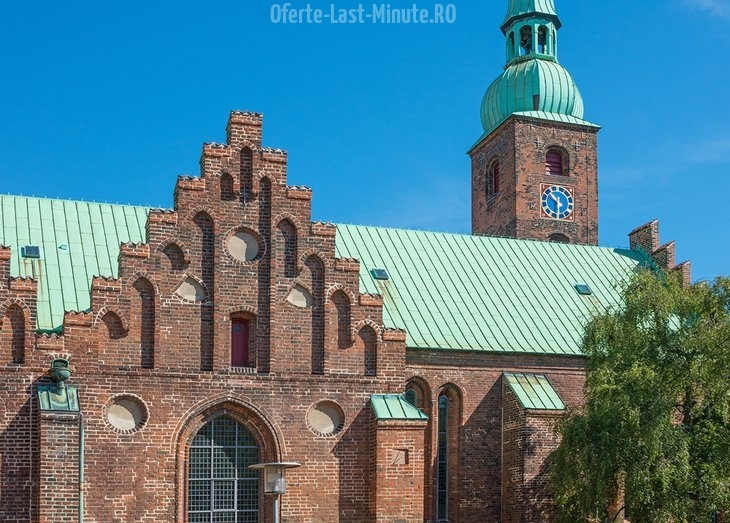 Built between the 13th and fifteenth centuries, the Church of the Virgin Mary (they will frue Kirke) was initially part of a Dominican priority and remains one of the largest churches in Denmark.Now a purely gothic building contains many fine frescoes and a magnificent altar dating from 1520. In no church and older was discovered during the 1955 excavations. Dating from the middle of the eleventh century, this stone church has been carefully restored and can be seen to visit the church.De asemenea, de interes este Sala capitulară, dedicată ca biserică și remarcabilă pentru picturile sale murale medie.nnAdresă: Vestergade 21, 8000 Århus C, Danemarca
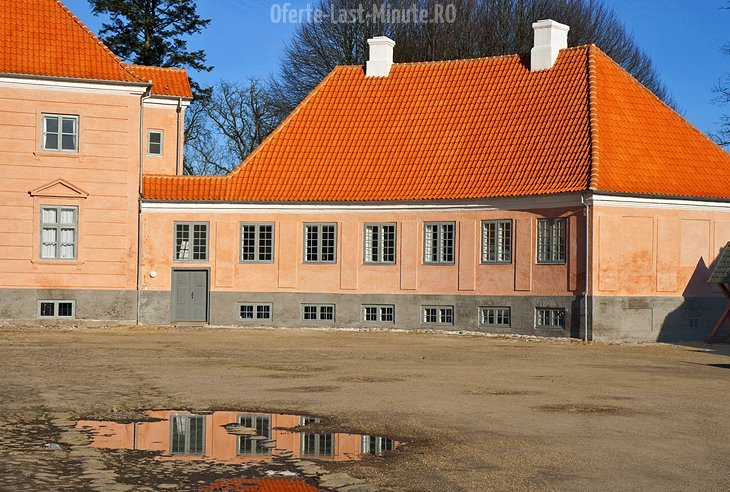 At a short car trip south of Aarhus is the beautiful Moesgård or Momu museum.Constructed on the field of the historical mansion Moesgård, where the initial museum was hosted, this well -designed attraction was opened in the autumn of 2014 and offers a comprehensive account of the history of Denmark, from the stone era to the Vikings era.perfectly preserved in a nearby swamp.There is also a cafe and a gift shop.Guided tours are available in English.This fun route snakes through the forests and fields of the estate, passing by the replicas of the prehistoric houses and the funeral mounds.
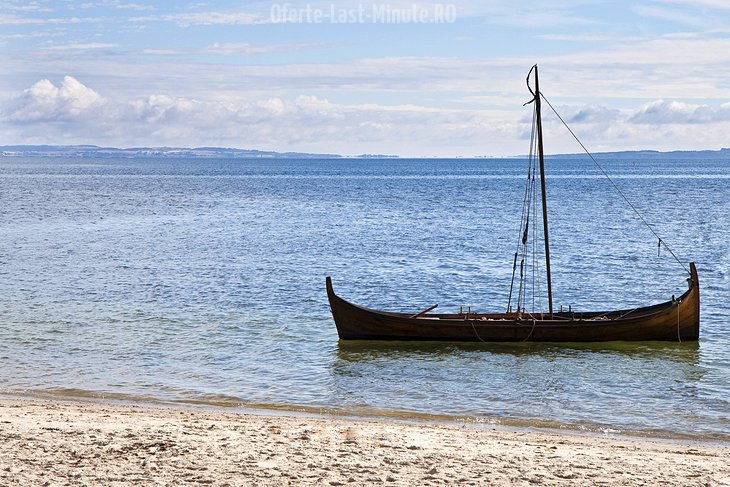 Located at the basement of a large bank in the city center, the Viking (Vikingemuseet) Museum consists of collections based on the discoveries made by the builders of the building in the 1960s.The remains of the meteries that once surrounded the settlement, a reconstruction of a typical house from the Viking period and ancient tools and artifacts.This fascinating weekend event takes place in July and attracts potential Vikings from all over Europe to share the culture and tradition of this fascinating period of Danish history.The festivities include fighting reconstructions and riding shows, together with the traditional Viking boats and navigation shows.
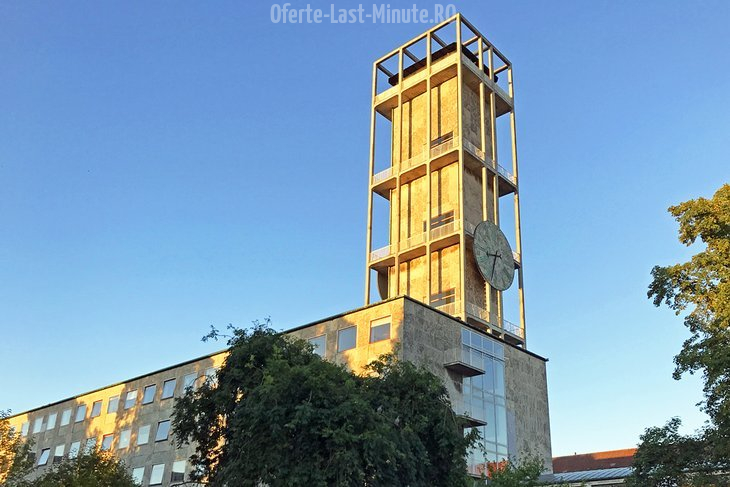 On the southern part of the crowded Rådhus Plads is the City Hall (Rådhus).Built in 1941 according to the plans of Arne Arne Jacobsen and Erik Moller, it is remarkable as one of the few such municipal buildings ever built in Denmark.The inner tours include a visit to the civic room, the council room and the marriage room, each beautifully designed and cut with ornaments and sumptuous wood accents.It looks more beautiful than it seems and represents a great background for selfies.At the foot of the Tower of the City Hall is a wonderful fountain called Agnes and the Water Carrier.
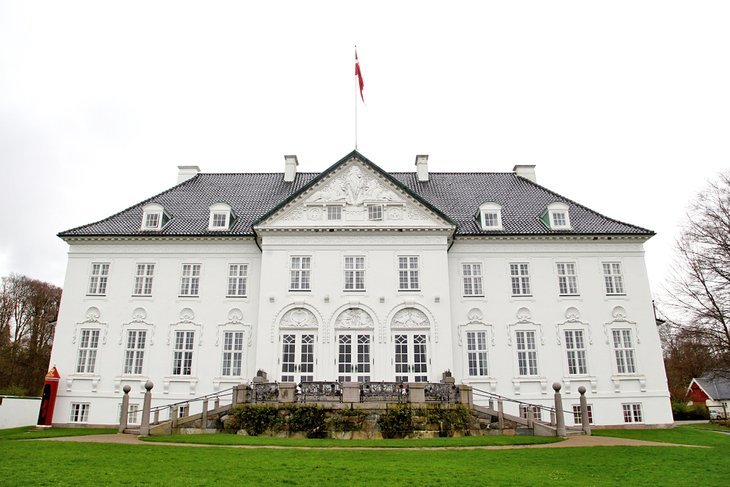 The impressive Marselisbor Palace (Marselisbor Slot) was built in 1902 as a gift from the Danish people and since then it has been the summer residence of the Danish royalty.While the palace itself is not open to the public, the gardens and parks around them are. In the attraction points of a visit to this park of 32 acres are large lawns with their numerous sculptures and ponds, as well as the flourishing gardens of roses and herbs.When the queen and her family are resident, the guard's change ceremony takes place every day at noon and is a show that is worth seeing.Arranged in the memory of the Danes fallen in the First World War, it is a pleasant place to reflect and spend time.
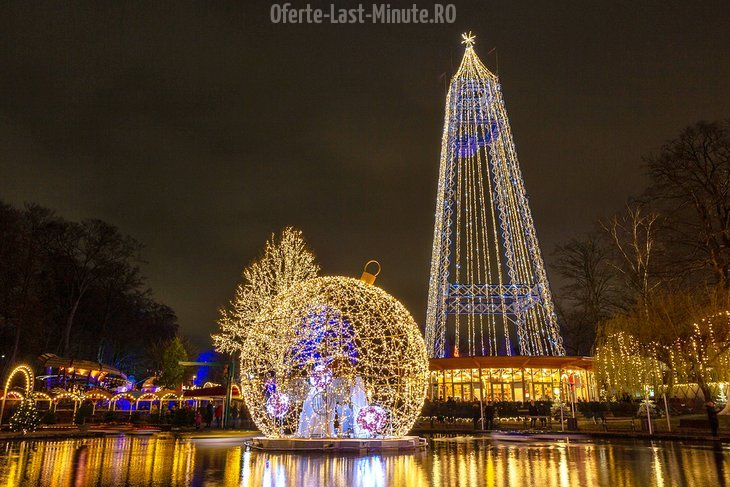 The children guaranteed to have fun at Tivoli Friheden, a fun themed park, focused on the family, located just two kilometers from the center of Aarhus and a few steps from the Marselisbor Forest.The more than 40 attractions include thematic walks, games, playgrounds and a 5D Cinemagic cinema.Holiday festivals bring new homework and decorations for Halloween and especially Christmas, when the light display is spectacular.

