
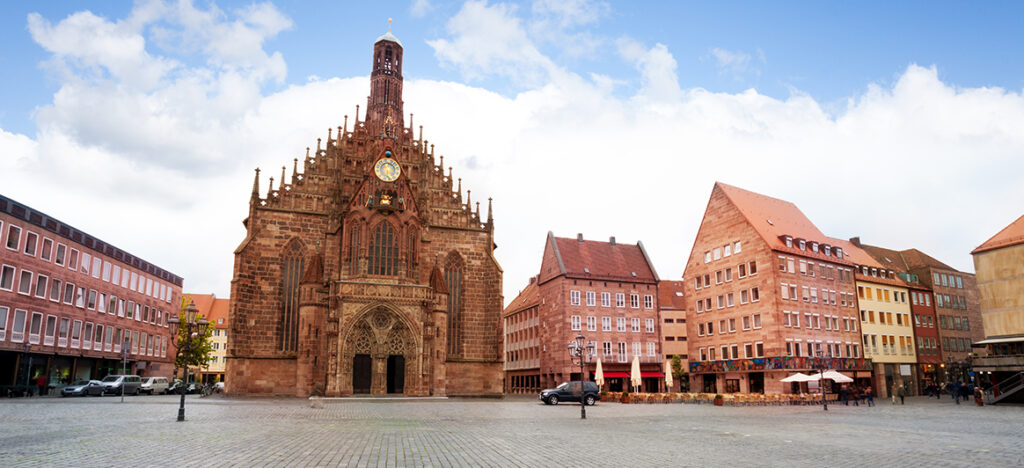
The medieval historical city of Nürnberg (Nürnberg) is one of the most important art and culture centers in Germany and one of the most popular tourist destinations.The city has also been associated for a long time with scientific and technological progress, especially in printing.He hosted the first typography in Europe and a center for the study of astronomy;Here was published in 1543 the most famous work of Nicolaus Copernic.
About
Best period
The best months for good weather in Nuremberg are April, May, June, July, August and September
January is the coldest month of the year
Tourist Attractions
 The Romanian Catholic Romanian (the Church of the Virgin Mary) dates from 1352 and is a mandatory gothic point.You will not easily miss when you visit Hauptmarkt in Nuremberg, because the amazing facade of the building is rich in details.For example, above the porch with its rich sculptural decor is Mänleinlaufen, a beautiful old clock that was installed in 1506 with mechanical figures representing the seven voters walking around Emperor Carol IV (daily shows at lunch).and two beautiful monuments by Adam Kraft.Visitors are welcome to participate here in daily meals.In Jakobsplatz, pedestrian, is another old interesting Roman-Catholic edifice, the church with Saint Elizabeth built between 1785 and 1806
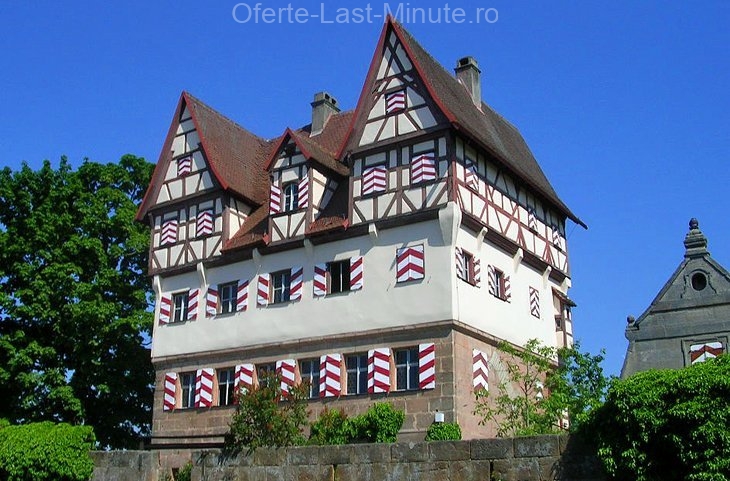 Located just nine kilometers north of Nuremberg, Schloss Neunhof is a wonderful old fortified house that was first mentioned in historical documents in 1246. One of the best preserved among the Nuremberg patricians, is one of the 60 such structures around the city as a defensive line.Mobile bridge, with beautiful decorated interiors, as well as with a splendid garden.Other notable attractions include the original gate, a variety of dependencies, including stables and gardens, and two kitchens.A subsequent addition that deserves to appear is the 18th-century chapel.
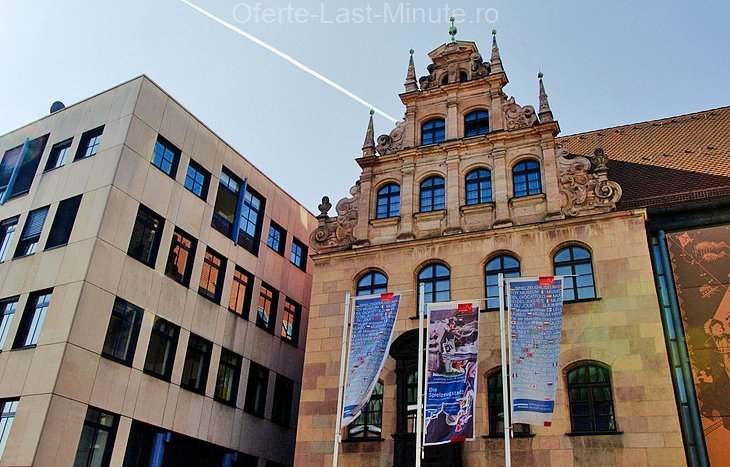 The excellent Museum of toys in Nuremberg (Spielzeugmuseum), considered widely as the main museum of its kind in the world, is a fun attraction for children of all ages - and adults.It is located in an old historical house dating from 1517. The culminating points of a visit include fascinating details of the cultural significance of numerous unique toys from different countries and periods.It is also worth noting the largest collection of toys in the world made by EP Lehmann, one of the most famous manufacturers of toys in the country, famous for their line of train models, some of which can be seen traveling along the big railway structure.On -site facilities include a well -supplied toy store, an outdoor play area (including a maze), plus a playground and interior boats.For those with interest to the stars, a visit to the planetary Nicolai Copernicus is another fun thing to do with the children.
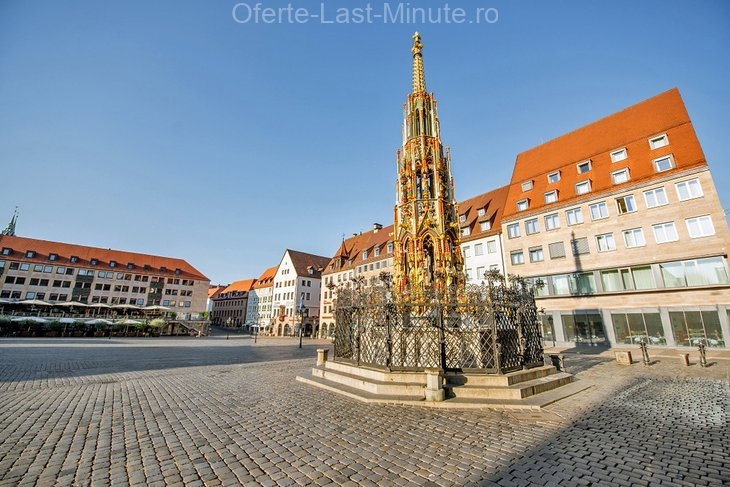 After your walk of the castle in Nuremberg, spending time exploring Hauptmarkt or the "main market" of the city.For centuries, the scene of a daily market - Wochenmarkt is a tradition that continues so far - Hauptmarkt is the traditional center of the city and houses the "beautiful fountain" of the fourteenth century, called properly.With its decorations and decorations, it is a perfect place for selfie (make sure you touch the famous gold ring for a place).Built in 1616, it is noted for its magnificent doors, prisons and torture room.Between these two buildings there is another famous fountain, Gänsemännchen.Built in 1555, it depicts a Franconian peasant carrying two geese with water flowing.More than one million visitors participate in this two -week extravagance every year and sees the market transformed by festivities and lighting, as well as stands that sell ornaments, Christmas and gifts (exploring its many stalls is a very fun thing to do at night).
 After spending time by exploring the beautiful Nuremberg (or even before you venture too far), you will undoubtedly find out more about the city's ascent over the years and how it has been at home to so many important historical attractions.If so, make sure you make time for a visit to the magnificent museum of the city of Fembo (Stadtmuseum im Fembo-Haus).Attraction points include the chance to see a variety of original rooms, from the medi era to the eighteenth century, complemented with authentic furniture and works of art, as well as one of the best surviving stuque ceilings in Germany.Traditional map printing workshop.Make sure you give yourself well-developed "audio and information and informatives, which use the real experiences of people in the city over the years to paint a fascinating image of the rich history of Nuremberg.
 Located only a few steps from the German National Museum is the Museum of Industrial Culture (Gewerbemuseum).Focusing on the industrial past of the city-and hosted in a former 19th century blacksmith-the museum takes a unique look at how the different industries with headquarters here, over the centuries, have had a cultural and social impact on Nuremberg.Vehicles, along with a cinema.The same building also houses the Motorcycle Museum, which celebrates an industry that started in Nuremberg in 1901. Particular attention is placed on the Zündapp local brand, which became important in the 1920s, with one of the first accessible models on the market.Other attractions include displays of historic racing bicycles and personalized cars.
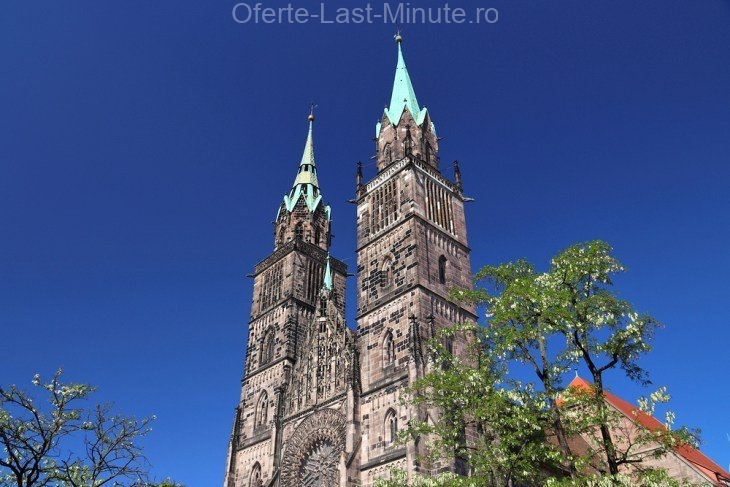 Pares Lorezer Platz, the spectacular Gothic church in the fourteenth century, Saint Lorent (St. Lorenz or Lorenzkirche), is the largest church in the city.One of its numerous notable features is a large window, with a diameter of nine meters, located above the beautiful western door.Other attractions include his tabernacle from the end of the fifteenth century;the crucifix on the big altar;The Krell altar, with the oldest representation of the city that survived;and the magnificent stained glass windows dating from 1477. In high notable characteristics include a unique organ consisting of three parts, with over 12,000 pipes, which is said to be one of the largest tools in the world and a set of 16 bells, of which the oldest dates from the 1300s. The attraction points nearby include the Fântuâ Virtuii in 1589 and in the form of 1589XIII.
 Nürnberg has the unique distinction to have kept most of its old wall circuit, many sections dating from the 14th-15th centuries and were later reinforced in the 16th and 17th centuries.In fact, one of the best things to do in Nuremberg for those who want to find their way in this fascinating medi city is to travel the nearly five kilometers of paths that follow the walls, leading to numerous gates and towers, many of which can be explored.For the best views of the walls, the old city and the burg, make your way to the impressive Fürther Tor, the medi gate located in the southwest corner of the city.Known as Lochgefängnisse, this old prison has 12 prison cells and a torture room.Guided tours are available in English.
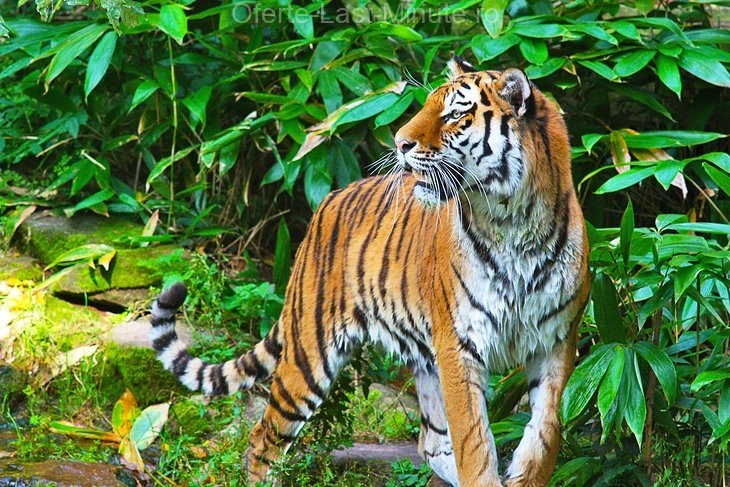 Another fun thing to do for those traveling with children is to pay a visit to the Nürnberg zoo (Tiergarten Nürnberg).Hosting more than 2,000 animals from about 300 different species, this world -waisted attraction was opened in 1912, but can follow its roots in the medi era, when exotic animals around the world were kept for entertainment by the local aristocracy.He prides with numerous animal shelves, including Siberian tigers, Asian lei, snow leopards, plains and African bivol.It is certainly a fun attraction to walk, due to a large extent the care and attention given to the enclosures, which are spacious and reflect habitats and natural landscapes.Other notable features include a popular dolphin lagoon with regular shows.If possible, try to plan your visit to coincide with the chance to see fed animals.Guided tours are also available in English.
 The German National Museum (Germanisches Nationalmuseum) hosts the largest collection in the country related to German art and culture.The museum has more than 1.3 million articles regarding the artistic and cultural history of the region, including historical documents on the parchment, a collection of 17,000 seals and a superb archive of plastic arts.There is also an impressive collection of historical musical instruments, a collection of sculptures and a fascinating exhibition of ancient toys and doll houses.and a former monastery.Guided tours are available, and a gift shop and a cafe are located on the spot. The namuze is also worth visiting, because it is located on Kartäusergasse, where you will find the way of human rights (Straße der Menschenchte), a monument along the street dedicated to World Peace., a popular gallery that presents exhibits of works of contemporary international artists.
 Right outside the walls of the old city is the magnificent Nuremberg Museum (Verkehrsmuseum Nürnberg).Consisting of a series of museums, including the DB Museum of Deutsche Bahn (the country railway) and the Museum of Communications, is a wonderful attraction to explore with children due to its numerous display-related display display.One of the oldest such museums in Europe - can follow its roots until 1899 - its collection also includes royal trains and steam and diesel engines, as well as a work replica of the first train in Germany.And for a truly memorable oracle experience, check the availability of one of the excellent charter trains that run regularly.Another museum related to transport to visit is the Merks Motor Museum, which houses an excellent collection of about 90 vintage cars.
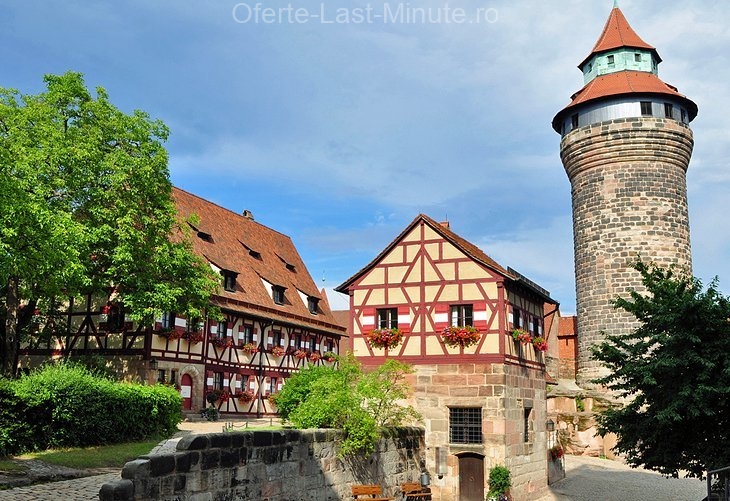 Dominating the horizon of the North-Western section of the old city (Altstadt) the group of historical structures that make up Nuremberg Castle, the Imperial Castle in Nuremberg (Nuremberger Burg), is erected to give its full name.This impressive 351 -meter high fortification is considered one of the most important surviving medi fortresses throughout Europe and was the residence of all the kings and legitimate German emperors from 1050 to 1571. In a very good way to get the most of a Castle visit is to participate in a fun.These two-hour informative tours in English visit and other important landmarks along the road, such as the city walls, the famous Hauptmarkt, the Albrecht Dürer Historical House and St.Lawrence. In the lower end of the castle are the imperial stables built in 1495 (now a youth fireplace), and the pentagonal tower, dating from 1040. Above is Kaiserburg, built in the eleventh century (although much modified in the subsequent centuries), together with the Sinwell tower with its view.Make sure you spend time exploring the Palas neighborhoods with its unique double chapel, both dating from the beginning of the 13th century.Many surviving artifacts in the long history of the castle can be viewed in the museum of the Imperial Castle, Bower.Here you will find an impressive collection of medi weapons and armor costumes, along with saddles and harnesses.Located in the old two -storey Old House attractive built in 1563, this even older structure created by a human falls at a depth of 50 meters and can be visited only with a tour guide (tours available every half hour).Make sure you explore the impressive castle gardens, an attractive place for a walk, which can follow its roots until 1525.
 Only a throw from the Nuremberg castle is the Albrecht Dürer House from the fifteenth century (Albrecht-Dürer-Haus).Here he lived the famous German Renaissance artist from 1509 to his death in 1528. The five -storey house itself dates from 1420 and now serves as a museum, founded in 1871 and dedicated to the life and work of Dürer (he was especially renowned for his printed maps).It hosts authentic vintage furniture exhibitions and a reproduction of Dürer's studio workshop, where traditional printing demonstrations can be enjoyed.Also, the kitchen with original fireplace is of interest, plus living spaces, which can be viewed.Guided tours are available. In the same time, it is worth noting the nearby Tiergärtner, a small medi market.Another famous old house is Fembohaus from the end of the 16th century, the best preserved old house of traders in the city, now occupied by Heimatmuseum, with its domestic interiors and posters related to the history of the city.
 St.Lawrence Side from Nuremberg, or Lorezer Seite - named after his main church, St.Lorenz - is in the section of the Old City (Altstadt) that is on the southern shore of the Pegnitz river.One of the busiest parts of the city, it is worth exploring for its famous Frauentorturm and Handwerkerhof Alt Nürnberg neighborhoods, two small wonderful wooden houses, renowned for their traditional craft workshops.Nürnberg.The culminating points of this old historical street include St. Marta Church in the fourteenth century (Marthakirche) with its fine stained glass
 The small baroque city Erlangen is a few kilometers north of Nürnberg and is famous for its university.His most notable building is Erlangen Schloss, built in 1704 and occupied by 1825 by Friedrich Alexander University.In the back of the building is SchlossGarten, a delightful formal garden designed in French and partially in English style, with a wonderful, but curious Huguenot fountain and the beautiful orange dating from 1706. In the northern part of the gardens are the Botanical Garden and the Botan Theater, as wellWorks of graphic art, including self -portraits of Dürer and Grünewald.
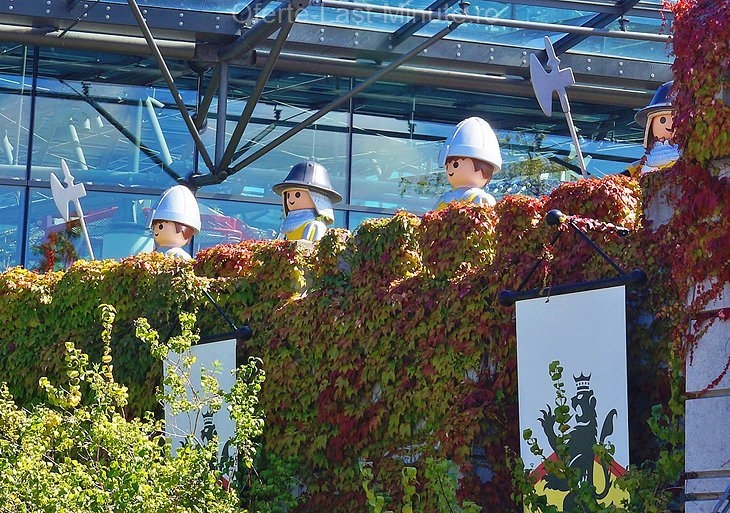 At a short trip with the Nuremberg car there are numerous fun attractions for children.One of the most popular is Playmobil Funpark.Located in the city of Zirndorf, at a slight distance by car west of Nuremberg, this interior / exterior theme park is suitable for the age of three years and over. In attraction points include complete dimensions (children's dimensions!) Of the numerous famous characters and accessories of the player, from a Gigant Pirate Castle.Other notable features include an Indian Indian village, a Wild West thematic area, a farm, a gold mine and even a dinosaurs display.Many of the exhibits are there to be played and climbed, such as string track, a maze and motor rows, which really add to the pleasure factor.And after all the fun game, go to the Kristall Palm Beach water park near Stein, a popular place for its many swimming pools and slides (plus facilities for parents, including spas and whirlpools).
 The Protestant Church of St. Sebald (Sebalduskirche), built between 1225-73, is proud of a magnificent Gothic chorus dating from 1379, with the Schreyer-Landauer tomb, the work of Adam Kraft.Inside, on a pillar in the northern aisle, Madonna is in an aura dating from 1420, while in the east choir is the famous tomb of Saint Sebald, a bronze masterpiece of Peter Vischer and his sons.A 1397 silver sarcophagus contains the remains of the saint, and Vischer himself is described with his leather apron and chisel. High culminating points of the church include a group of veit stoss dating from 1507 and a huge emergency with 6,000 pipes.to participate in a 1.5 hour private tour through the church towers;The spaces are limited for this event twice a week, so you arrive early to buy your tickets. N No other notable Protestant Church is St. Jacob Church (Jakobskirche) in the Jakobsplatz pedestrian area.
 The Documentation Center The Nazi Party Rally Grounds (Dokumentionszentrum Reichsparteagsgelände) is one of the most important museums in Germany, dedicated to the darkest chapters in the history of the country.Located in a wing of the congress hall where rallies of the Nazi party were held, its most notable exhibition is called fascination and terror and treats many facets of the brutal time of the Nazi regime in power.square kilometers), as well as the Nuremberg processes that took place here after the war.Guide tours are available in English with prior notification and audio tours in English and video display are offered;You can also take details about a self-guided tour on the full field of the rally.This fascinating exhibition refers to the war processes that took place here after the Second World War and is located above the real court used at that time.In addition to learning the remarkable history of this medi city - both old and modern - you will see points of interest, such as the courts of the imperial castle, the house of Albrecht Dürer and the Church of St.Lawrence during this four -hour informative tour.

