
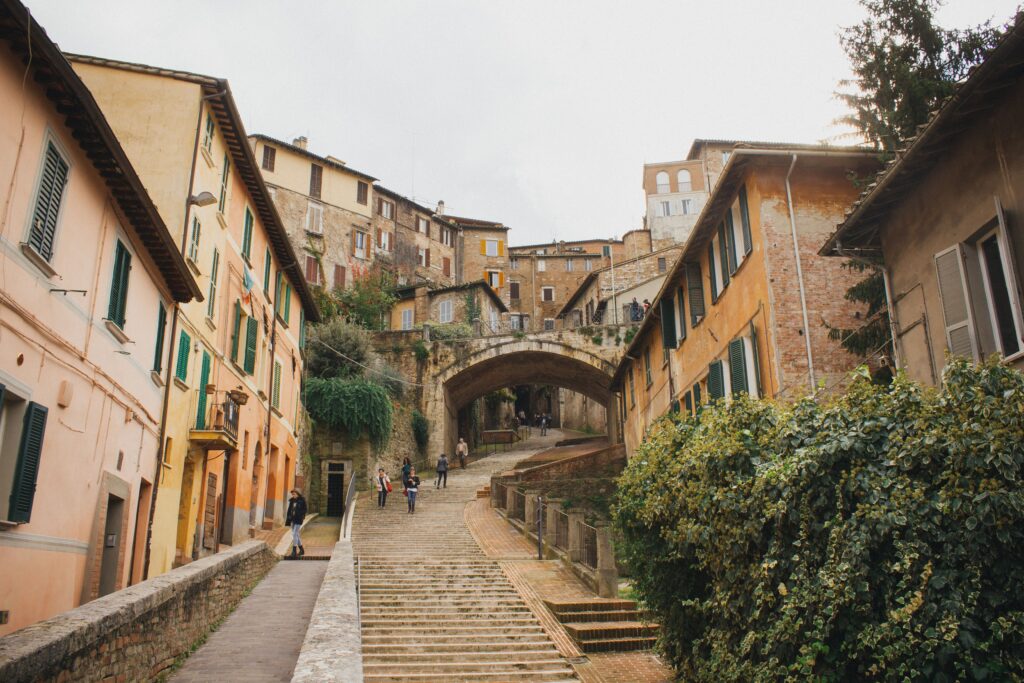
Perugia, the capital of the Umbria region, is worth visiting not only for the beauty of the decor, but also for its old buildings.Before entering the Roman domination, the ancient Perusia was one of the twelve cities of the Etruscan Federation and considerable sections of the Etruscan walls were kept, which stretched 2,800 meters around the city.
About
Best period
The best months for good weather in Perugia are April, May, June, July, August, September and October
On average the hottest months are July and August
January is the coldest month of the year
The rainy Mondays are May and November
Tourist Attractions
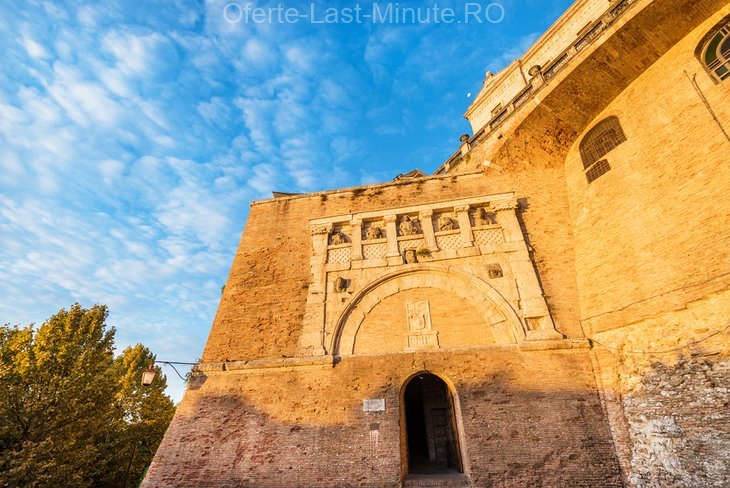
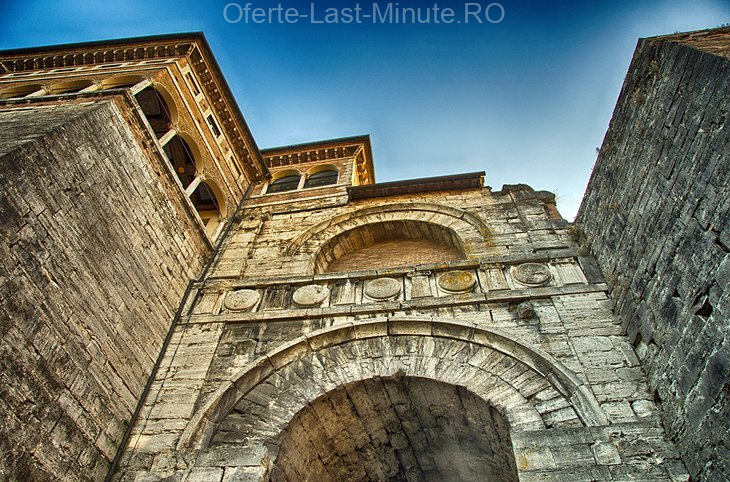 Once upon a time one of the seven gates that allowed access through the Etruscan walls that surrounded the Perugia, Arco D 'Augusto was built in the second half of the third century BC.but he takes his name from the Roman emperor who restored it in 40 BC.after the conquest of the city.Due to the walls and the high position of the Perugia, Augustus managed to conquer the Perugia only after a siege of seven months.The two ports of the gate connect two trapezoidal towers.The loggia from the top of one of them was added to the Renaissance, and the fountain below that tower was completed in 1621.
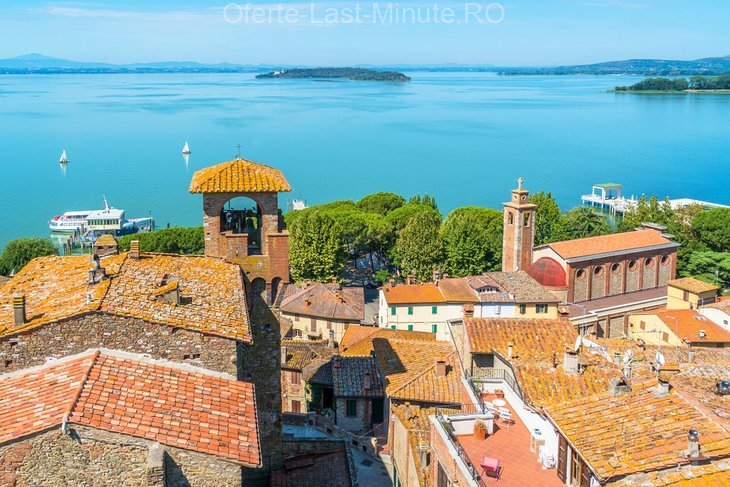 To the west of Perugia, Lake Trasimno is the largest Italian lake south of the PO Valley, with an area of 128 square kilometers.Feed almost exclusively with rainwater, its volume varies greatly depending on the season.From a historical point of view, Lake Trasimene is famous as the scene of the Second Punic War, when the Carthaginians under Hanibal defeated the Romans in 217 BC in the northern side of the lake is the small ancient city Passignano Sul Trasimeno, with an old castle;On another promontory above the western part of the lake is Castiglione del Lago, also with a castle.
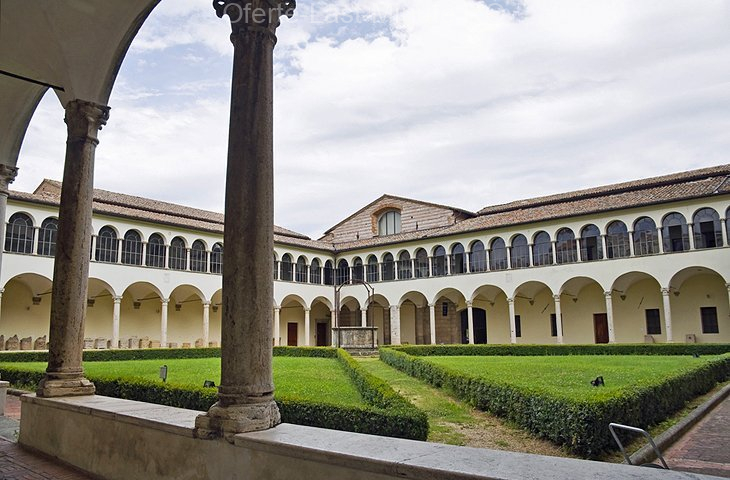 In the former Dominican monastery that is adjacent to San Domenico there is Museo Archeological Nazionale dell umbria, with Roman and Etruscan antiques from the Bronze and Iron Age, some dating from the sixteenth century BC.Î.Hr., the longest known Etruscan inion.The collection includes funeral urns, Etruscan and Roman bronzes, jewelry, gold works and works recovered from the graves from the Hellenistic period.
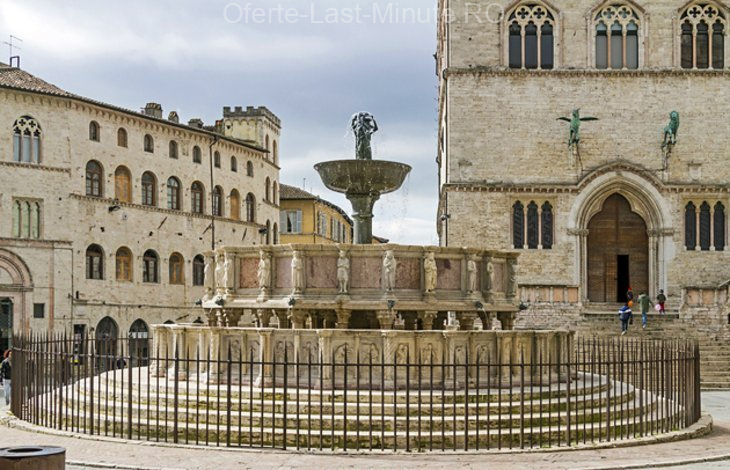 In the center of the attractive main market in Perugia, Piazza IV Novembre, Fontana Maggiore from the 13th century is one of the most beautiful wells of that period, with reliefs of the master Tuscans carving Nicola and Giovanni Pisano.The two basins with several faces are made of white and pink stone, and above them, a trio of bronze nymphs support a ballot box.In the western part of the market is the archbishop's palace with the Museum of Natural History, and beyond it is the arched vault of Palazzo del Podesta, which burned in 1534. From Piazza IV Novembre, via delle medi goes to Piazza Fortebracio
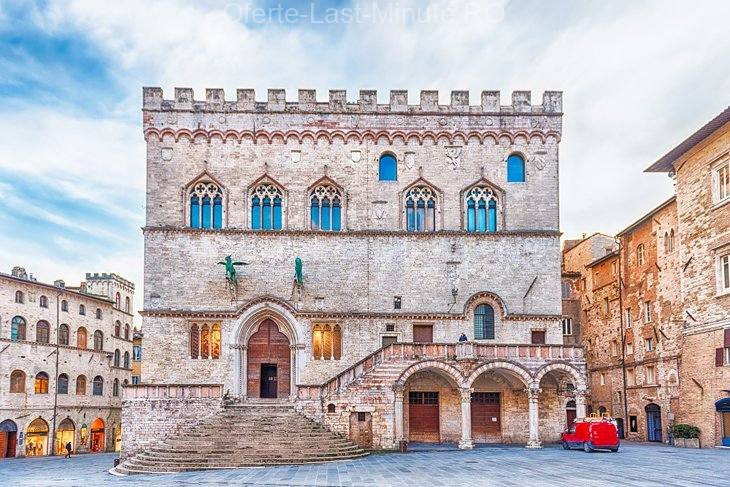 The National Gallery in Umbria, on the third floor of Palazzo dei Priori, contains paintings of Perugino;Pinturicchio;and other artists of the School in Umbria, including Benedetto Bonfigli and Bartolomeo Caporali;as well as sculptures of di Cambio and di Duccio.Demonstrates the development of painting in the shadow from the Middle Ages until the 20th century, its largest strengths being between the 13th and 18th centuries.Five 1281 statues by Arnolfo di Cambio;Madona with the baby of Duccio di Boninsegni, painted in 1305;a Madona with saints from 1456 by Benozzo Gozzoli (1456);a polyptic of Sant 'Antonius de Piero della Francesca;and another of Fra Angelico dating from 1437. In the Cappella dei priori there is a frescoic cycle by Benedetto Bonfigli, completed between 1454 and 1480 and depicting Perugia at that time.In the chapel there are several works of Perugino, a polyptic of Saint Augustine de Pinturicchio and sculptures by Agostino ducio.San Lorenzo
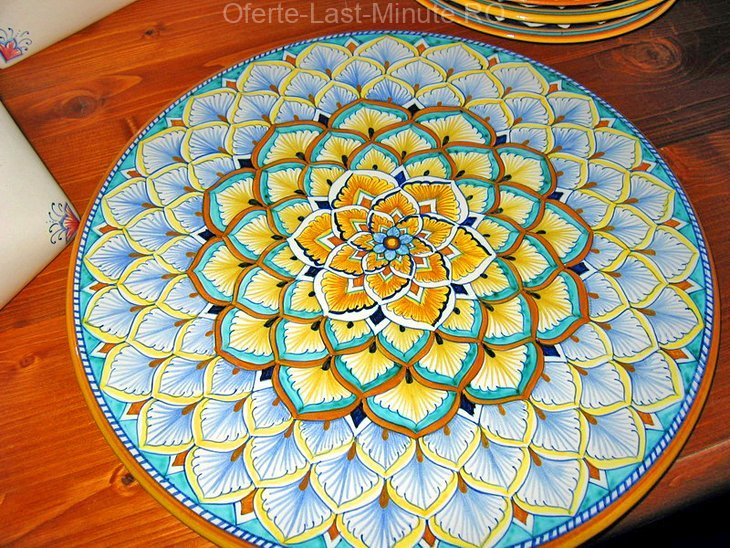 About 20 kilometers south of Perugia, the confuse is a center for shadow ceramics, and the shops that sell these lively painted articles fills the small city.To see a few beautiful old pieces, visit Museo delle Mailiche from the first floor of Palazzo Communale.The city itself is attractive and is worth walking on its atmospheric stone streets.
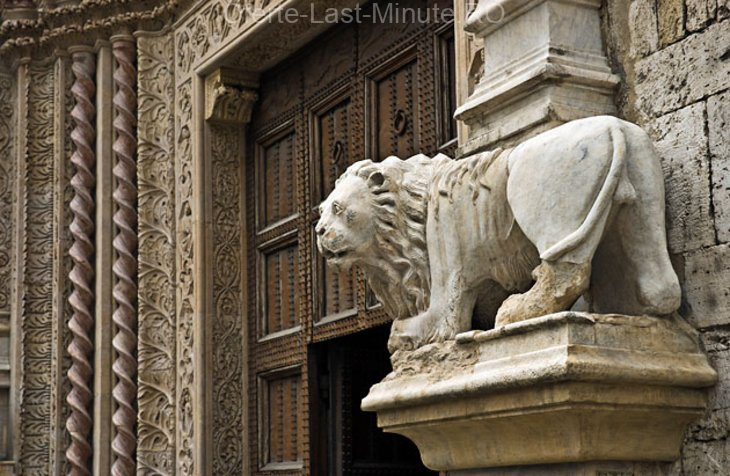 On the southern part of the cathedral is Palazzo Dei Priori, also known as Palazzo Communale, a massive Italian Gothic style from the end of the 13th century and the beginning of the fourteenth century.On the side of Piazza IV Novembre there is a griffon (Perugia's emblem), a lion of bronze from the fourteenth century and chains, all commercially commemorating the victory of the Perugia on Siena in 1358. In the first floor of the palace, entering the main door with Vannucci, VanThe room is covered with frescoes from the end of the 13th century with biblical and allegorical scenes.The banker's guild was one of the most powerful in the city, and their headquarters and exchange are richly decorated.The entrance of carved wood is just the beginning of the things to be seen here.But it is the dell room 'Udienza (audience room), which is considered the best and best preserved secular hall of Italy in the fifteenth century.The walls and vaults are decorated with frescoes by Perugino. N nadresa: Corso Vannucci, Perugia
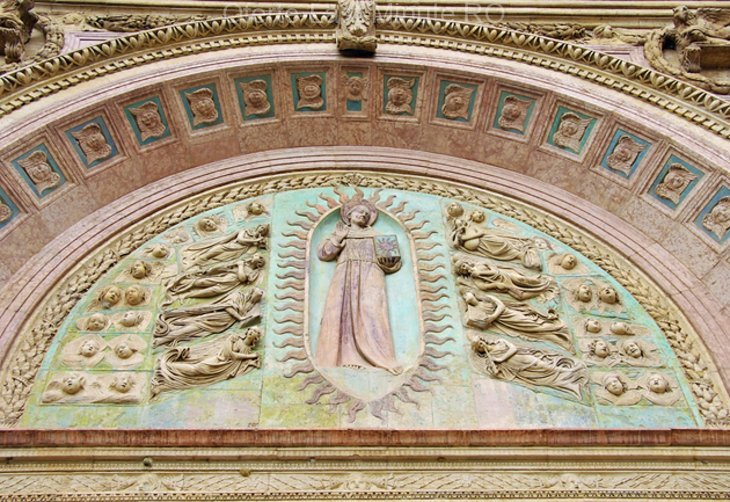 The magnificent facade of the oratorio di San Bernardino, made of colored marble, limestone and athearted terracotta, was created between 1457 and 1461 by Agostino Ducio, the best known as the artist responsible for Tempio Malatesta in Rimini.His semi-rotund bas-relief in the central arc is the most important Renaissance work in Perugia.A paleo-Christian sarcophagus of the fourth century serves as a basis for the big altar, behind which there is a door that leads to the oratory of Saint Andrew, with wooden ceiling of 1558 and painted decorations and stuccoes from the 18th and 19th centuries.
 One of the most unusual places to see in Perugia is buried deep under the streets and delightful old markets.His story dates from 1540, when Pope Paul III, a member of the Farnese family, led the Italian states.Baglioni.Over 100 houses, houses, churches and monasteries, some dating from the Etruscan and Roman era, were destroyed, and their stones were used to build the fortress.What tourists can see today are the vaulted foundations and the passages that were once streets, now deep underground. In this free attraction is easy to access from the rolling stairs that take you from parking or Piazzale PartiGiani to via Baglosoni Baglosoni (there is no via Farnese, so).Inside, an excellent art film reporting Rocca History and Perugia is worth seeing
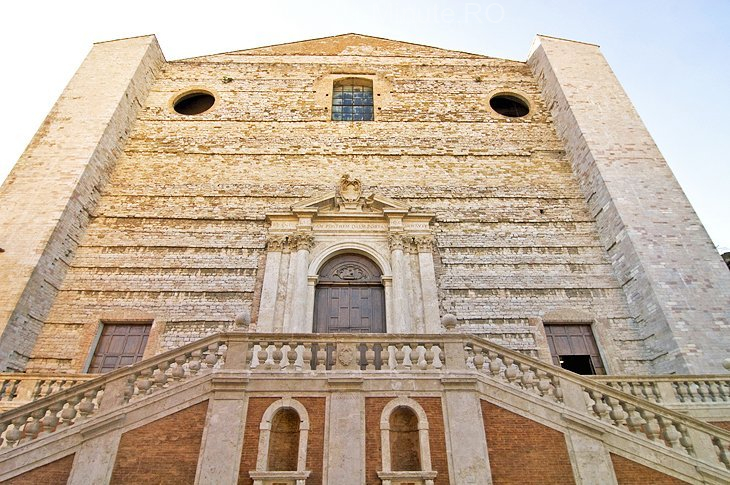 The San Domenico brick church was started in 1305, but shortly after it was completed, the top section proved unstable and demolished.In 1614, the nave pillars collapsed, and with them the vault they supported, so that the church was modified during its reconstruction from 1621 to 1634.of the apse.If you notice a resemblance between the design of this church and the cathedral, it is because this style of gothic room was the inspiration for San Lorenzo later.fresco remnants of the fifteenth century attributed to Benedetto di Bindo;The fifteenth-century retabloul of Agostino Ducio from the Madonna del Voto chapel;and Pope Benedict XI, one of the best examples of Gothic walls of the fourteenth century. N Nadresa: Piazza Giordano Bruno, Perugia
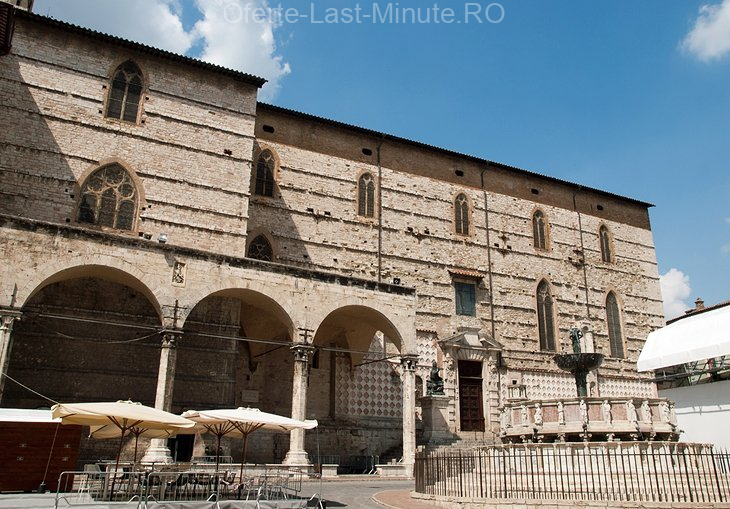 The Gothic church of the fifteenth century San Lorenzo, the Cathedral of Perugia, has an unfinished facade, despite the fact that its building continued from the laying of the foundation stone in 1345.Ash that was built in the fourteenth century from older fragments of stone.The decorations of the stucco and the painting on false marble are a plus of the eighteenth century, and the mannerist door from the sixteenth century was moved here from Collegio del Seminario.In the sacristy, to which you can reach the chapel to the right of the Great Altar, there are frescoes from the sixteenth century by Giovanni Antonio Pandolfi di Pesaro.To the east of the Cathedral, the Church of San Severo contains a fresco of Rafael, third.
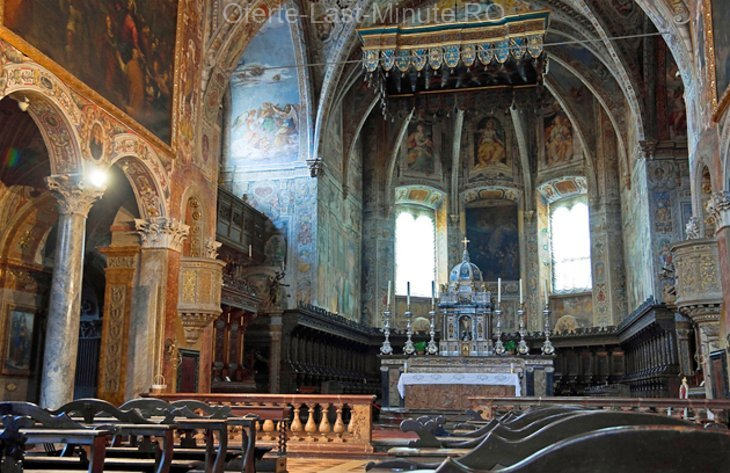 Outside the Port of San Pietro is the church of San Pietro, an early Christian structure rebuilt in the 12th century, incorporating 18 of the ancient columns.The beautiful gothic wooden choirs, completed between 1535 and 1591, are considered among the best in Italy. The painted and golden wooden tavan is from 1556, and the church is still decorated with frescoes and paintings of a number of artists, including Antonio Vassilacchi, Sassferrato, Guido Reni, Vasari, Guerricino, Guerricino and Perruurino.In the sacristy there are inlaid furniture and paintings by Perugino, Parmigianino and Rafael.To the southwest of the church, Giardini del Frontone extends to Porta San Costanzo, with beautiful views.
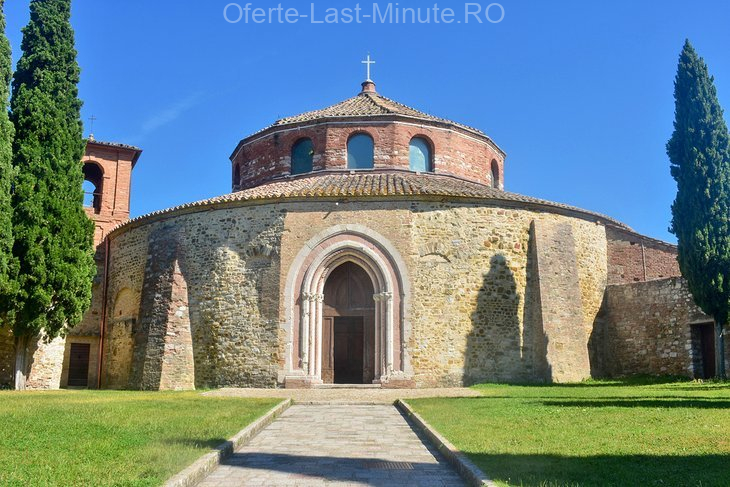 In the Borgo Sant 'Angelo neighborhood, near the old northern gate of Porta Sant Angelo, there is the Round Church Sant ' Arcangelo, built between the V-VI centuries.This Paleo-Christian temple incorporates 16 columns with Corinthian capitals, reused from an older pagan temple.The architecture is the early Romanesque with some Byzantine influences;The columns separates the central vessel from the raid around it.There are also crosses in the style used by Templar Knights.The restorations from the twentieth century revealed windows that had been filled, as well as the remains of early frescoes.

