
Brussels, the capital of Belgium, the main headquarters of the Belgian Royal Family and the capital of the European Union, is a remarkably small city, easy to go for all its importance.
About
Best period
The best months for good weather in Brussels are April, May, June, July, August and September
On average the hottest months are June, July and August
January is the coldest month of the year
Tourist Attractions
 In 1200, the Cistercian nuns founded a monastery here, which was later destroyed in the sixteenth century, but then rebuilt.Baroce. In the interior there is a painting by Albert Bouts (the mockery of Christ) and the altar of St. Bonifaciu, bishop of Brussels from the 13th century.The monastery windows are decorated with the arms of over 40 abbots and nuns
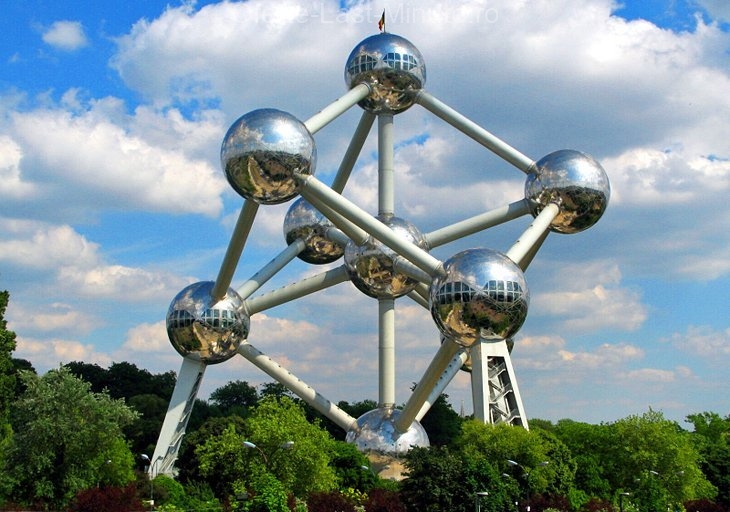 Together with Manneken Pis, Atomium is the best known reference attraction in Brussels and, although it is a tram trip, the bizarre steel and aluminum structure of 102 meters high, designed by architect André Waterkeyn for the World Exhibition in Brussels in 1958, is the most overlying of 1958the city.The lower spheres host a permanent exhibition about the history of structure.The upper sphere has incredible panoramas in the city.
 Dedicated St. Michael and St. Gudula (Holy Patrons in Brussels), this Gothic church was first founded in 1225, but was completed only in the fifteenth century.Ruysbroeck. In the beautifully proportioned (108 meters on 50 meters) is generously furnished and houses remarkable stained glass windows.And Maria (Nordic transet), then in the chapel of the Holy Sacrament, to the left of the choir, where the window illustrates the story of the host's miracle.
 The Koekelberg neighborhood is dominated by Massiva Basilique National Du Sacré Coeur (National Basiliek Van Heilig Hart), the fifth largest church in the world and created by Leopold II, started in 1905 to mark 75 years since birth.However, impressing with its pure dimension (141 meters on 107 meters). In the interior there is an excellent art collection and a continuous exhibition about the history of the basilica.The binoculars can be rented on the spot.
 This wonderful 1906 building, designed by Victor Horta, hosts the wonderful comic Strip Center, dedicated to cartoons and comics in the country that gave the world to the world and Tintin.Docuses the increase of the popularity of the bands of Belgian and French comics through an intelligent collection of original manus, sketches and imaginatively reconstituted sets, including Lucky Luke and Tim, Strouppi and Captain Haddock's monthly rocket.
 Although Château Royal, the Belgian Royal Family House, is not open to the public, the park that surrounds Laen is.From Paris since 1900. In the greenhouses, raised during Leopold II, they are the highlight of the gardens and are open to the public in April and May, when many of the plants are in flower.
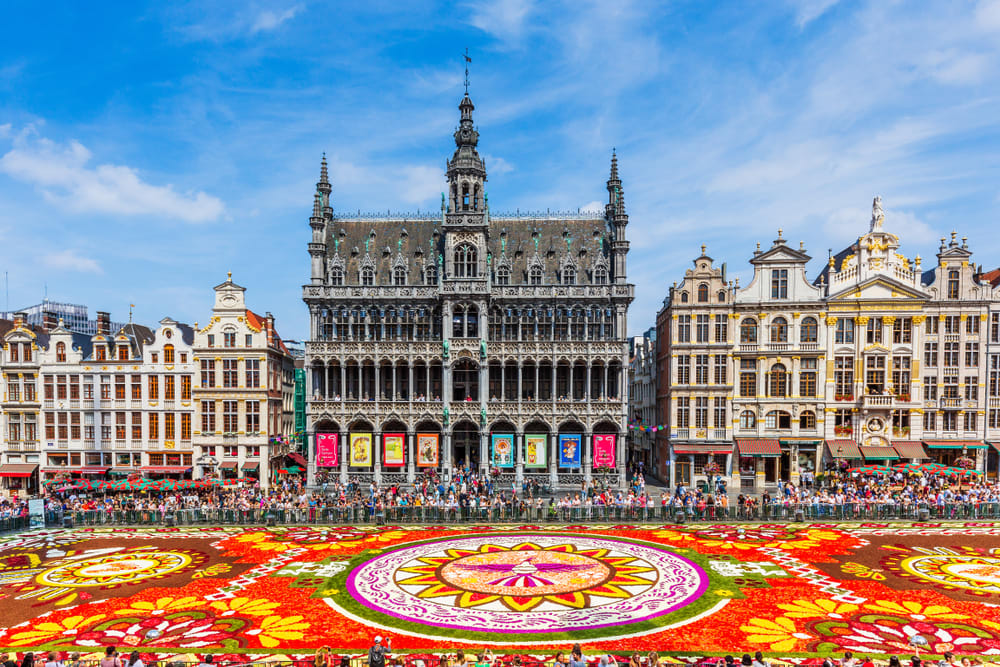
 Even in the heart of the old city of Brussels, the main market of the city (known as Grand Place) is one of the best preserved in Europe. NO Much of the elegant character of the market is due to the unique architecture of its elegant Gildehuizen (guild houses) with Frontones, pilasters and their magnificent railing,gold.The harmony of its architecture is obtained by the short construction period here, most of the buildings erected between 1696 and 1700. N Nistoria Grand Place dates much earlier.It was set up for the first time in the eleventh century and evolved shortly thereafter, to become the political and economic center of the city.Among the most impressive are the Maximilian camera, hung with the tapisari from Brussels;The great chamber of the Council with a superb ceiling by Victor Janssens and the tapestries in his drawings;The great banquet room and marriage room, both beautifully lambed;And escalator D 'Honneur, with mural paintings that illustrate the history of Brussels.
 Along the street of Rue of L '' Etuve is the best known landmark in Brussels, Manneken Pis, usually besieged by a lot of tourists.Legends.According to one, the fountain is a memorial of a brave baby who avoided a conflagration, according to another, he commemorates the son of a contained impulse while participating in a procession.During the big holidays, events and festivals in Brussels, the statue is famous for being dressed in costume.
 Mont des Arts was created between 1956 and 1958, occupying the high place between Place Royale and Place de L 'Albertine.The Albert I library was founded during the Burgundian rule and includes over three million volumes, together with a valuable collection of manus and some interesting museums
 The Royal Museum of Fine Arts in Belgium (1875-81) combines four separate art museums, which together are one of the largest and best art galleries in the world.It was transferred to the new Musée Royaux in 1846. The Old Masters has a collection of famous Flemish and Dutch Old Masters.Among the known works presented here are the worship of Gerard David, Mourning of Christ Van der Weyden, Pietà de Petrus Christus and the judgment of Emperor Otto of Dirk Bout.It combines the temporary exhibition halls with the basement galleries of the Fin-de-de-Siècle Museum, dedicated to art works from the period between 1884 and 1914, when Brussels was one of the cultural capitals of Europe. In the vicinity of the main building is the Magritte Museum, dedicated to the work of the Belgian surreal artist.It is the largest Magritte collection in the world.
 Parc du Cinquantenaire a fost înființat în 1880 pentru a comemora a 50-a aniversare a țării.nnPiesa sa centrală este monumentalul Palais du Cinquantenaire , ale cărui două aripi, legate în 1905 de un arc de triumf masiv proiectat de arhitectul francez Charles Girault, găzduiesc două dintre cele mai interesante muzee dinBrussels. In the Royal Art and History Nmuses, it hosts the National Archeology Collections in Belgium, with pieces drawn from all over the world, as well as one of the most extensive collections of tapisari in the world.A whole of the development of military technology and major campaigns worn on the Belgian territory.
 The Church of Notre-Dame du Sablon from the fifteenth-XVI centuries.Due to its wonderful stained glass windows. It is also of interest to the funeral chapel of the Thurn und taxis family, partly the work of Luc Fayd 'herbe.He had shown the Virgin.
 A favorite attraction for photos, the most important building on this market is the Royal Palace (Palais Royal), which is used by the Belgian royal family as an official residence.Available free guided trips inside the palace, which take place in the big reception rooms and rooms.Voor Schone Kunste) on the west side of the market, designed and built in the 1920s by Victor Horta, are two of the best examples.
 One of the most unique things to do in Brussels is the exploration of this active archaeological site, which was rediscovered in the 1980s.To allow tourists the opportunity to explore, and the museum has free audio guides that take you through the excavation site.

